FIRE! Modern Combat – Core Rulebook
We got pointed toward FIRE!, a modern combat ruleset from Spain, by the folks at Team Würfelkrieg. This isn't our first rodeo with modern combat skirmish systems as we've previously spent time with Force on Force, Black Ops, Spectre Operations, and Asymmetric Warfare, and now we want to share our impressions on FIRE! with you.
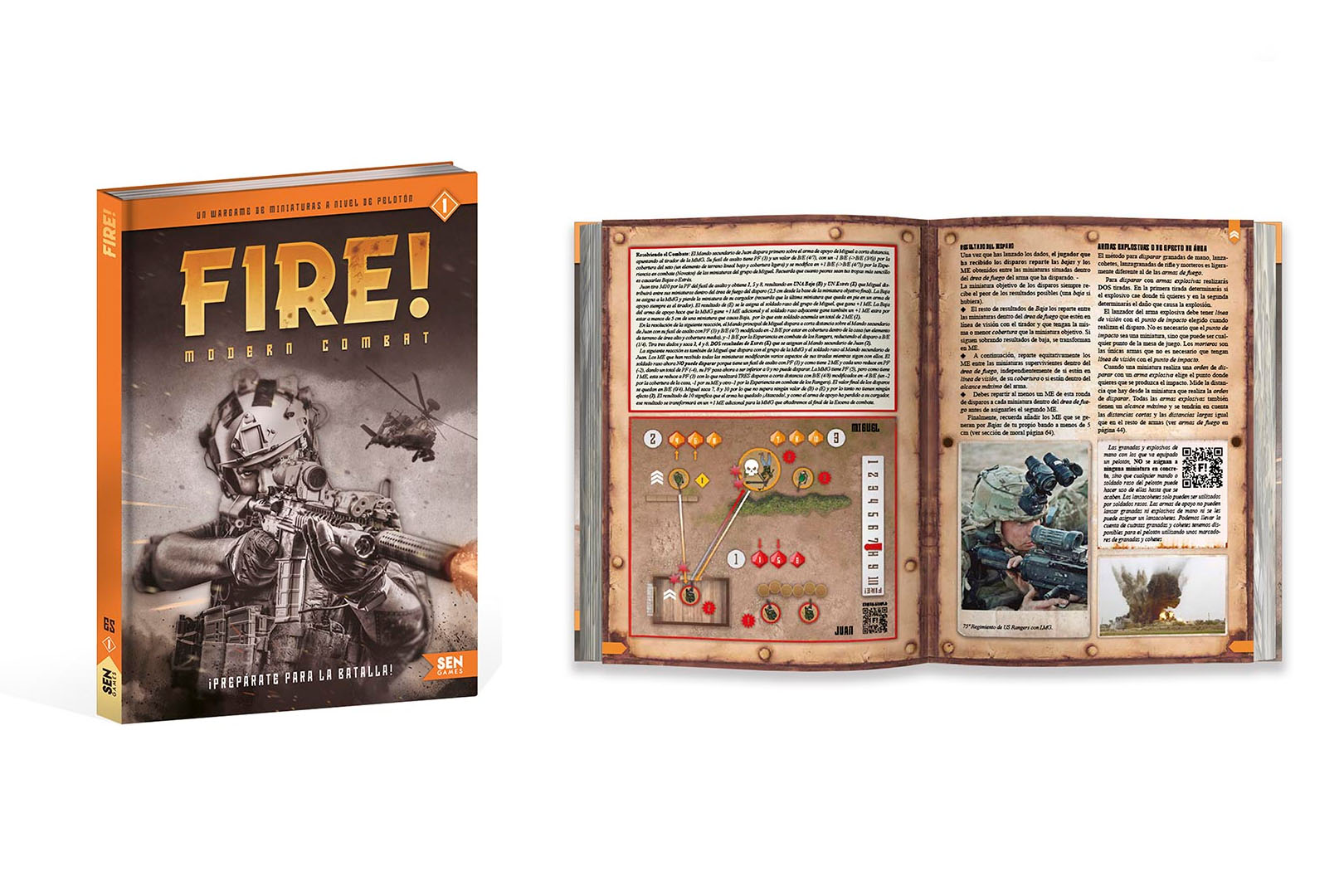
The game is available in different variants. You can pick up the hardcover rule book itself for 27,95 EUR (available in four different languages: English, Spanish, German and French), or as a FIRE! boxed set for 129,95 EUR, that comes with two small squads (US Rangers and Insurgents) as well as cardboard scenery and dice. SEN Games offers FIRE! markers that are available separately.
What Is It About?
FIRE! Modern Combat is a squad-level skirmish miniatures wargame from SEN Games, a small independent publisher based in Barcelona. The game grew out of designer Ricardo Ponz's own gaming group, who spent years being mildly dissatisfied with existing modern combat rulesets and eventually decided to write his own. That house-rule seed grew for roughly a decade before becoming a standalone product, funded via Kickstarter in early 2025 (343 backers, ending at 39.600 EUR against a 9.500 EUR goal).
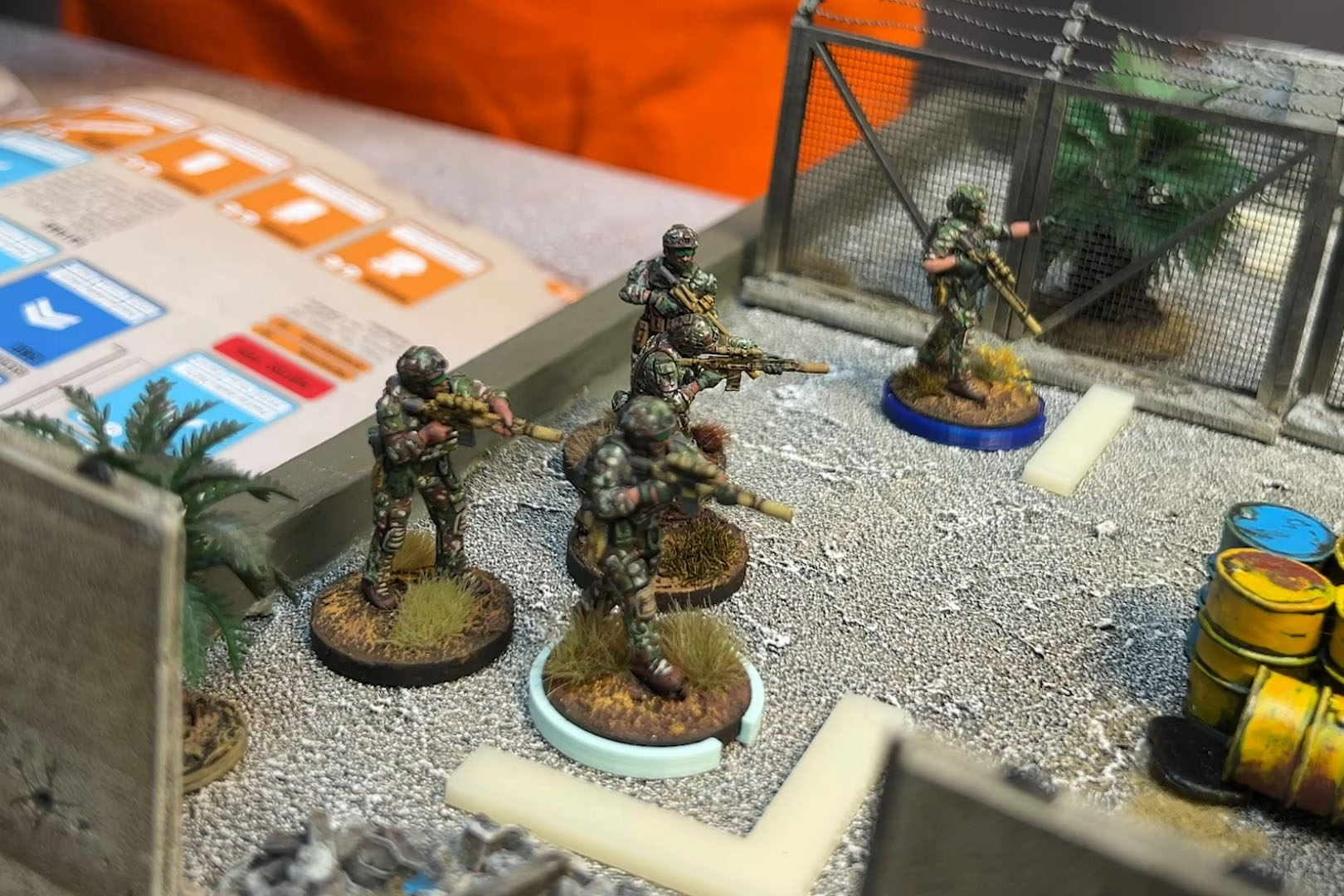
Mechanically, FIRE! could handle skirmishes anywhere from the Korean War to today, but the core rulebook's focus (army lists, scenarios, equipment) is squarely on the 1990s to present. But as profiles and weapon lists are kept on a generic level, you could easily adapt it to various settings with a bit of research. This is one of the reasons why SEN Games does not only cover the rules, but books on various conflicts as well.
FIRE! is built for two players, is scenario-driven, and is typically played at 500 to 600 points, which translates to roughly 8 to 15 models per side. Games run around an hour on a 4x4ft (120x120cm) table, a very manageable footprint for a squad-based skirmish game.
First Impressions
We received the rulebook as a review sample, along with a handful of reference cards. At an MSRP of 27,95 EUR, this is a proper hardcover, 144-page, full-color book with sewn binding and glossy finish on the cover. On paper, that's a fairly ambitious spec for the price point, and it holds up: the book feels genuinely well produced, not like a print-on-demand afterthought.
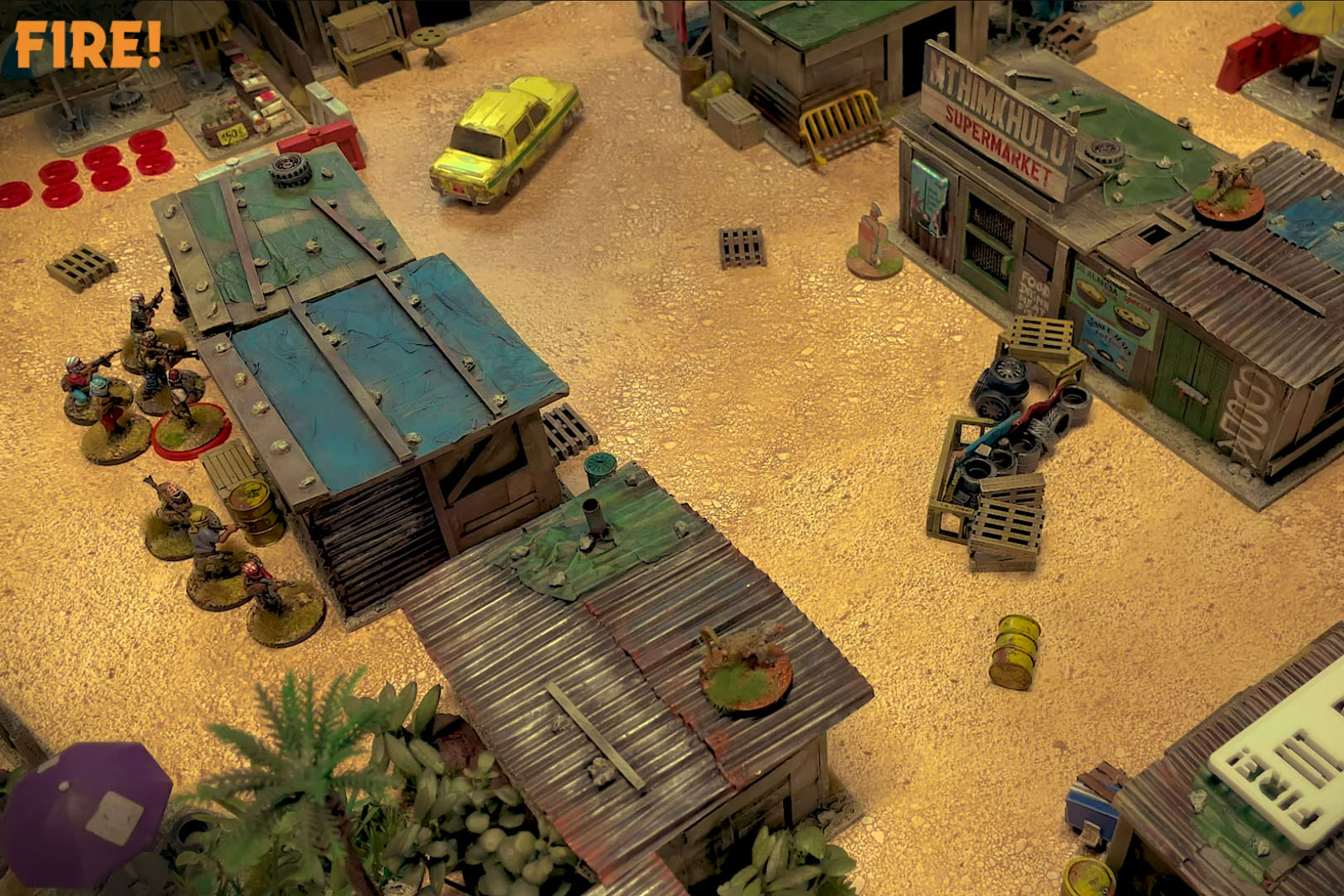
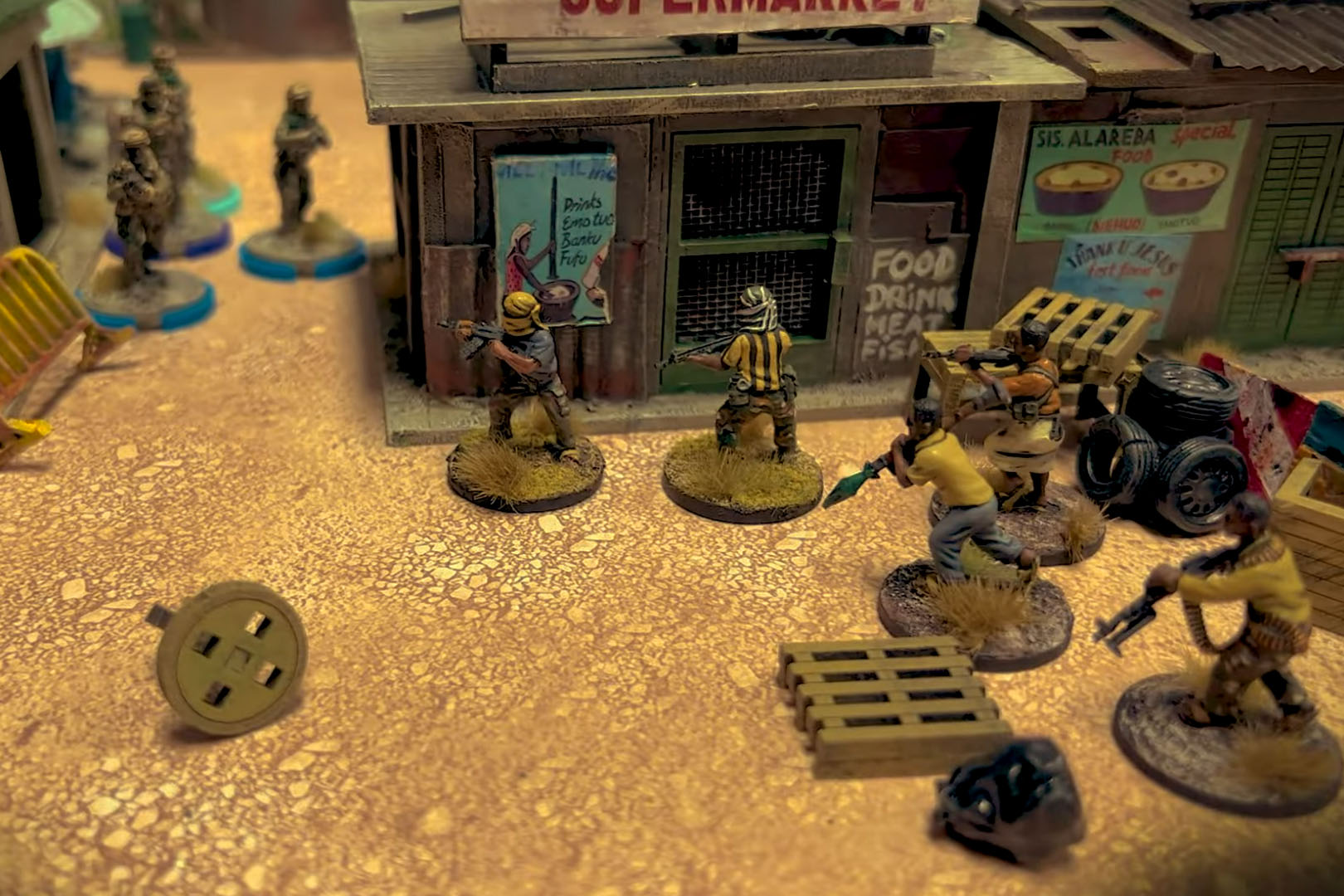
The layout backs that up. It's cleanly organized into five sections (Introduction, The Game Begins, Advanced Rules, Scenarios, and Additional Features) and makes generous use of illustrations and step-by-step diagrams to walk through examples of play. A nice touch is that the photography mixes real conflict and troop imagery with the usual painted-miniature glamour shots, which fits the game's straight-faced, realism-first tone. SEN Games also backs the book up with example videos on YouTube, which is a good sign for anyone who prefers to see a turn played out rather than just read about it, and for certain sequences this makes the order of battle easier to grasp.
One small production quirk: a few pages show the Spanish-language diagrams faintly showing through underneath the English ones. It's not a dealbreaker, but it's noticeable once you spot it. On the translation side, having a full German edition is a genuine plus for our audience, though the German text occasionally reads a bit stiff and technical rather than conversational.
How Does FIRE! Play?
The headline design decision is ditching classic IGOUGO in favor of an Act/React system. That's not unusual for this genre; it's practically become a hallmark of tactical, squad-level modern combat games, and it fits the material well.
Every model's profile is built from two core attributes plus its loadout: Training (Militia, Regular, or Elite) and Combat Experience (Green, Experienced, or Veteran), on top of equipment and weapons. Line of sight is a full 360° for most models, with the notable exception of certain weapon teams that are restricted to 180°, a small but sensible detail for crew-served weapons.
Here's the loop: at the start of a turn, each player generates a pool of Command Points (CP) based on squad Training, with bonuses for commanders present and penalties for casualties taken. A Combat Sequence then opens with a Roll for Initiative, determining who acts first; that player spends CP on orders, and the opponent spends CP to react. This repeats, sequence after sequence, until both players have burned through their CP pool, at which point the turn ends. If nobody's met the scenario's victory conditions yet, a new turn begins.
Orders include Move (up to 20cm, with penalties for terrain, climbing, or jumping), Move and Shoot (halved movement, shooting penalty), Assault (melee), Fire, and a set of special actions such as Overwatch, Get Down, Reload, Remove Stress Markers, Spot a Sniper, plus scenario-specific orders. Activating the same model more than once in a sequence costs extra CP, and orders can cost more if the commander is too far from the model being ordered. One detail we particularly liked: ranges are only measured after orders are declared. You commit to the plan before you know if it's actually in range, which adds a nice bit of pressure to every decision.
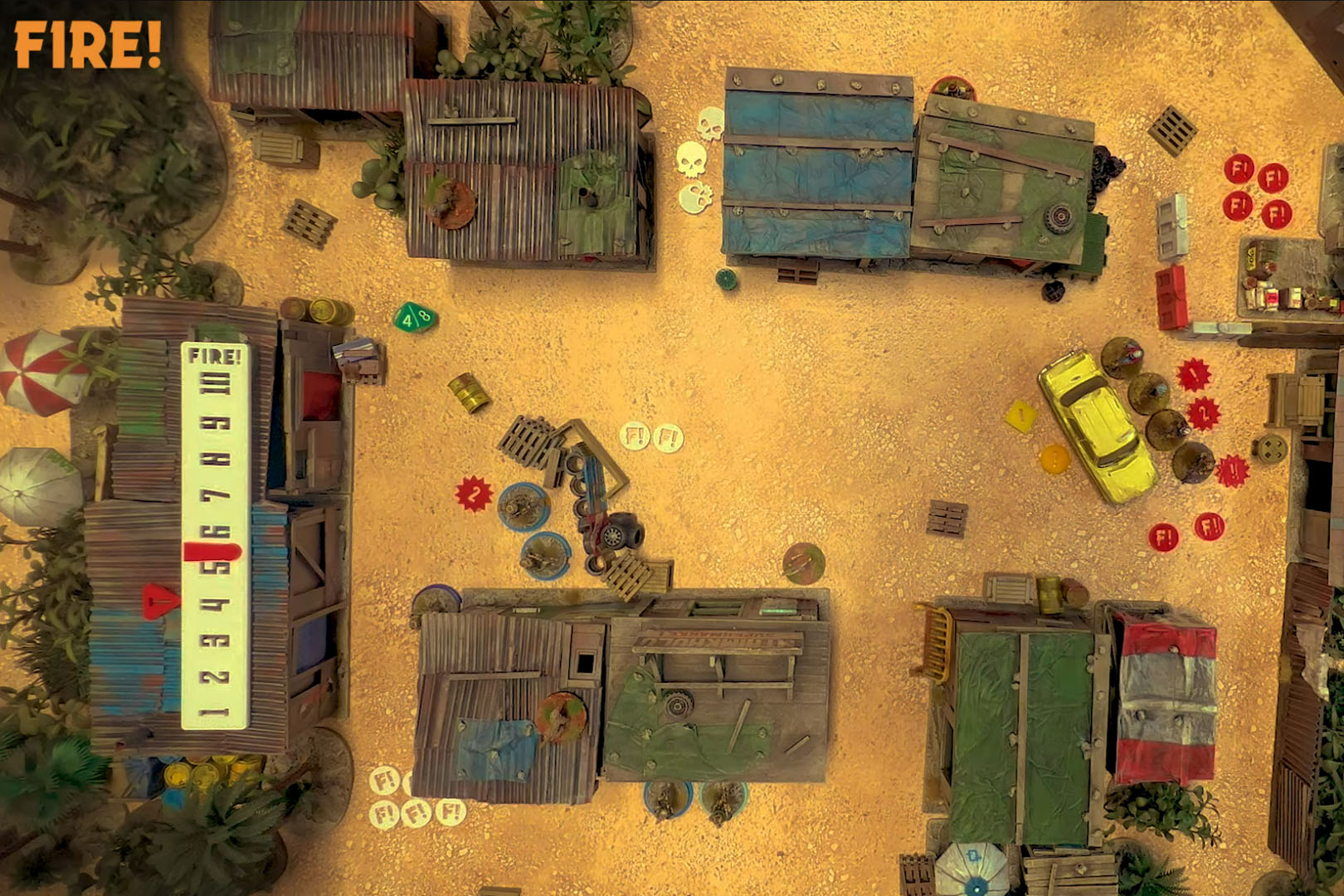
The initiative mechanic itself uses a numbered strip (1 to 10) and a d10. A marker sits between two numbers, starting at 5/6, with each end of the strip belonging to one player; whichever range of numbers faces you is your side of the roll. Win initiative, and the marker shifts toward your end, meaning the player who's been on the back foot gradually finds it easier to seize the initiative over time. It's a small rubber-band effect that keeps games from snowballing too hard in one direction.
Within a Combat Sequence, things play out in real time: the model being shot at has to decide immediately how it reacts, whether to fire back, take cover, or something else. Rolls for Action Priority (which determine the order in which actions actually resolve) use a pool of 3d10, and Reactions use 2d10 (bumped to 3d10 if the model was on Overwatch), taking the lowest die in the pool. This creates a genuinely layered sequence: initiative is won, an action is declared, that action triggers a reaction, and only then is priority rolled to see who actually goes first. In principle, the unit you're shooting at can return fire before your own shot even resolves. It's a clever way to simulate the chaos of a firefight, but it does mean you need to stay switched on, even with relatively few models on the table.
Weapons are defined by Range, Rate of Fire (the number of d10s rolled), a Casualty/Stress (C/S) value, an Anti-Tank flag, and any special rules. To resolve fire, you roll a number of dice equal to the weapon's Rate of Fire and compare results against the C/S value, with modifiers for things like target movement, cover, and quality. There's no save roll or armor check in the traditional sense: casualties are simply removed, and body armor instead shifts the weapon's effective C/S threshold. Fire (and nearby losses) also generates Stress, which penalizes certain checks, and mounting casualties trigger morale checks that get progressively harder as a squad's losses pile up.
A couple of personal observations: it's a little unusual that a model's own quality doesn't factor into its chance to hit. Only the target's quality matters for the defensive side of the roll, while the shooter's skill is essentially baked into its equipment and Rate of Fire rather than the roll itself. Rolling under a target number, on the other hand, isn't a learning curve issue at all; plenty of well-regarded systems do exactly that. What does take real concentration is the nested initiative, action, reaction, priority sequence. It's not as bookkeeping-heavy as Spectre Operations can feel, but it's noticeably less frictionless than Asymmetric Warfare, even with a comparably small model count on the table.
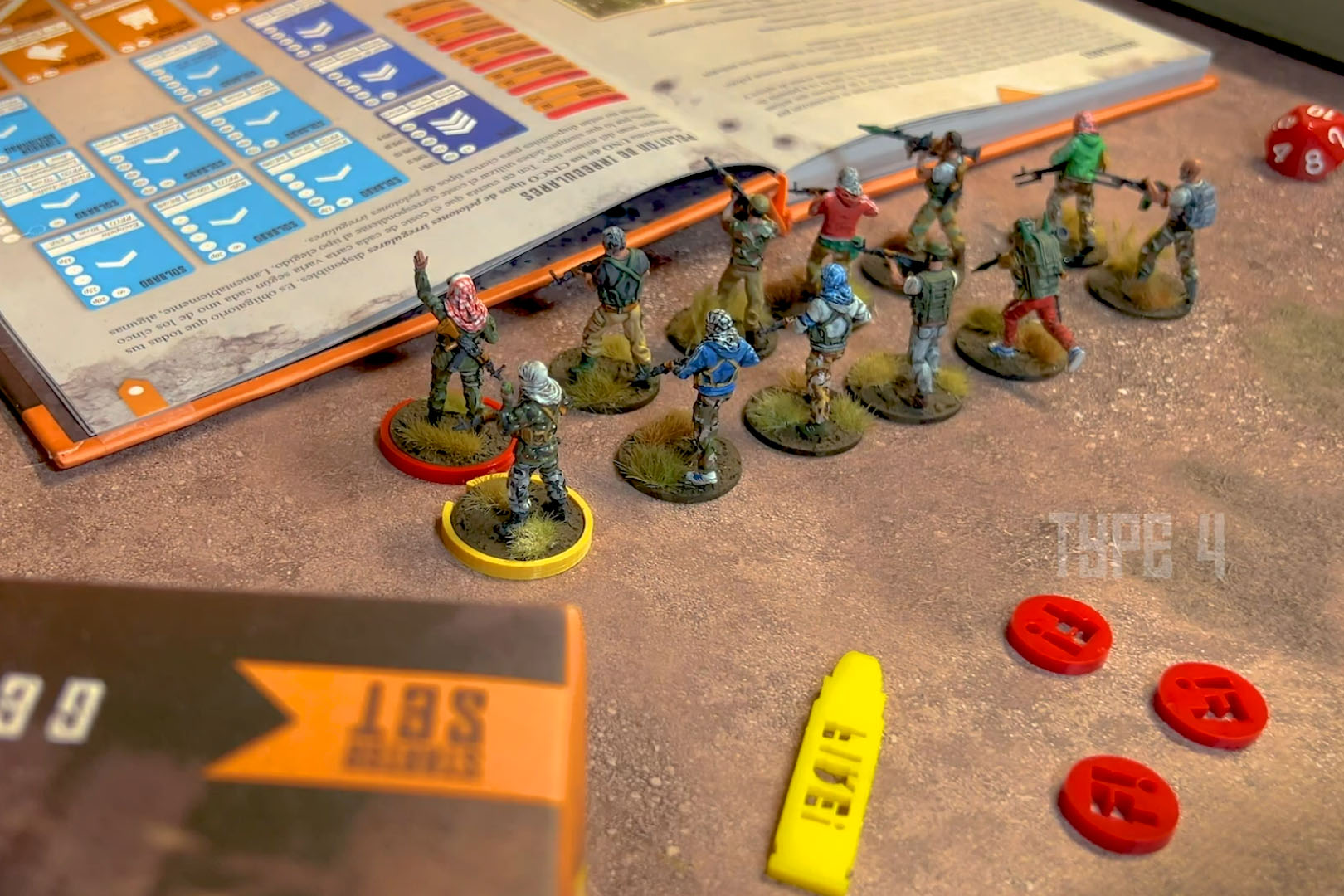
On the army-building side, the core book covers a solid spread of factions: the US (Army, Marines, Rangers, SpecOps), the UK (British Army, Royal Marines, Paras, Gurkhas, SAS, SBS, SRR, SFSG), France (Armée de Terre, Légion Étrangère), and Spain (Spanish Army, Legionarios, Cazadores de Montaña, Infantería de Marina), plus a generic Irregulars list flexible enough to represent more or less any non-state actor you want. Free downloadable PDFs currently extend that with forces from Germany, China, Italy, and Australia.
Scale is left officially open, but the book's own reference point is 28-32mm miniatures on 25mm bases, with vehicles at 1:56 to 1:43, and all measurements are given in centimeters rather than inches, a small but welcome nod to a non-Anglo audience.
What's Next?
SEN Games treats FIRE! Modern Combat as its flagship title, and by their own account they intend to keep growing the miniature ranges and, longer term, branch out into board games, card games, and narrative publishing. For FIRE! specifically, near-term output looks to be mostly new miniature releases, alongside free downloadable army lists and scenarios for additional nations, a sensible, low-friction way to keep the game growing without forcing existing owners to buy a new edition. One small inconsistency worth flagging: the War Journalist rules are sold as a separate paid PDF rather than bundled for free alongside the corresponding miniature, which feels like an odd choice given how generous the rest of the post-launch support has been.
Conclusion
At 27,95 EUR, FIRE! undercuts Spectre Operations (around 52 EUR) while sitting above Black Ops (around 15 EUR), and for that price you get a genuinely nicely produced hardcover with a full German translation available, which is a real point in its favor for our audience, even if that translation occasionally reads a touch technical.
On paper, the rules read as a solid middle ground between casual pick-up-and-play and full simulation: the learning curve is steeper than a total newcomer might hope for, but nowhere near as demanding as something like Infinity. If you've already got mileage in other games from the genre and are looking for a fresher, more decision-driven take on modern skirmish combat, FIRE! is worth a serious look.
What stands out most is how deliberately the design leans into decision-making over dice-chasing. The action/reaction loop and the sliding initiative track mean that even a quiet-looking turn on the table is full of small, consequential choices: when to break cover, when to hold fire, when to gamble on winning priority instead of playing it safe. That's exactly the kind of tension the "wargaming dad" crowd tends to appreciate, since it rewards planning over raw dice luck and doesn't demand hours at the table to pay off. It's also a system with obvious room to grow: the scenario framework and the generic Irregulars list make it easy to bend FIRE! toward settings well outside its modern-day comfort zone, from Cold War proxy conflicts to near-future skirmishes, without waiting on official support to catch up.
SEN Games hosts a Youtube channel for FIRE!, where you can find additional content to the game, as well as a full battle report, for better understanding the rules. They also sent us their TVE miniature set alongside the rulebook, so expect a dedicated look at those miniatures in a separate review soon.
FIRE! is a rule set by SEN Games
The reviewed product item was provided by the manufacturer.
Enjoy this article?
Like us on Facebook
Follow me on Instagram

Categories
- battle report (5)
- events (212)
- fantasy (612)
- General (162)
- historical (651)
- Little Big Adventures (4)
- offtopic (5)
- reviews (555)
- science fiction (714)
- showroom (108)
- terrain (120)
- work-in-progress (423)









Leave a Reply