Legions Imperialis – Reaver Titan with Graviton Obliterator and Volkite Annihilator
This new Reaver Titan with Graviton Obliterator and Volkite Annihilator is the third boxed variant of a Reaver Titan, after the Reaver Titan with Gatling Blaster, Laser Blaster, Power Fist and Carapace Apocalypse Missile Launcher, and the Reaver Titan with Melta Cannon, Chainfist and Carapace Turbolaser Destructor.
With this box, we conclude our brief series on the latest releases for Legions Imperialis and Adeptus Titanicus, thanks again to our sponsor Radaddel.
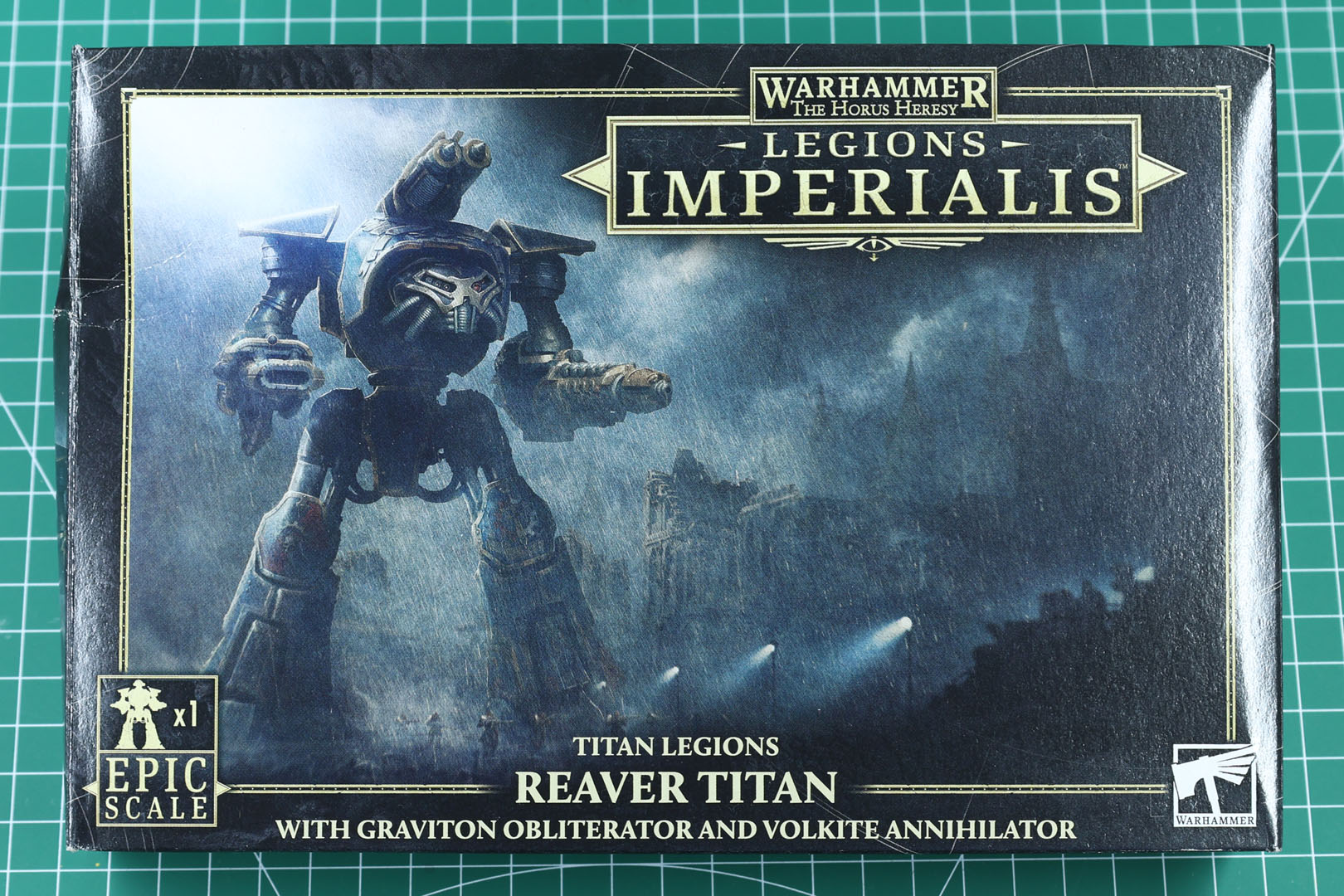
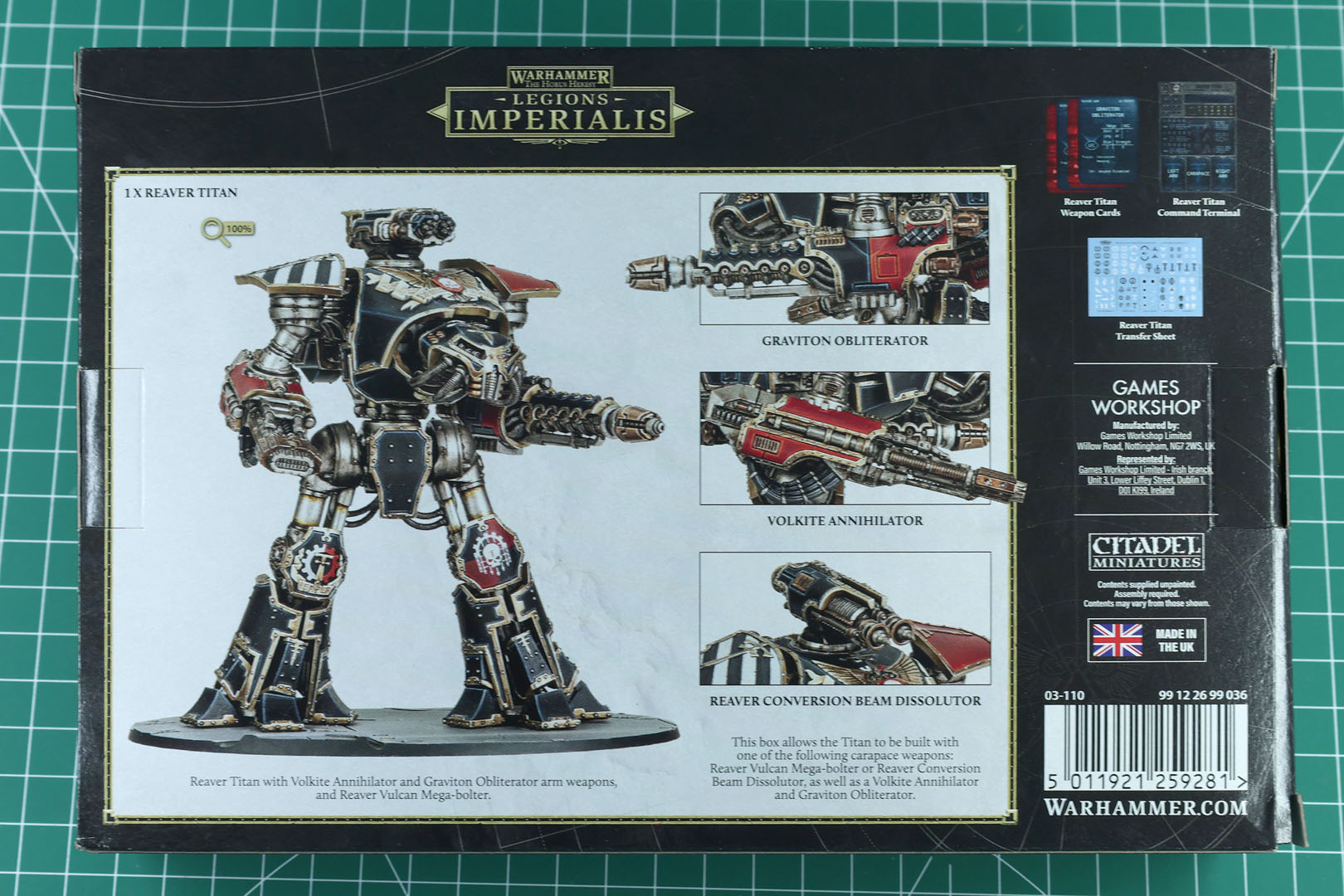
Just like the two other kits, the pre-order for the Reaver was opened on July 18th, with public release on August 1st. The new options in plastic are either available as a full kit for 51,50 EUR or just the Mail Order exclusive sprue for 23 EUR.
The boxed set provides everything you need to use the Reaver Titan in Adeptus Titanicus right inside the box: a Command Terminal plus Weapon cards covering the included armament. The sprue-only upgrade only covers the plastic and nothing else. The rules for using it in Legions Imperialis are covered in the core rulebook (p. 214) and the Liber Strategia (p. 162) rather than in the box.
Legions Imperialis – Warlord Titan with Volkite Destructor and Macro-Gatling Blaster
Among the freshly released Warlord Titan variants, the Warlord with Volkite Destructor and Macro-Gatling Blaster sits alongside its sibling kit, the Warlord with Quake Cannon and Conversion Beam Extirpator, as options four and five for the chassis. Joining the existing line-up of the Warlord with Volcano Cannons and Apocalypse Missile Launcher, the Warlord with Power Claw and Plasma Annihilator, and the Warlord-Sinister Psi-Titan.
We use this release to revisit and update the reviews of the Warlord Titan with the support of Radaddel, and cover today the second new Warlord Titan kit, with Volkite Destructor, Macro-Gatling Blaster and Graviton Ruinator.
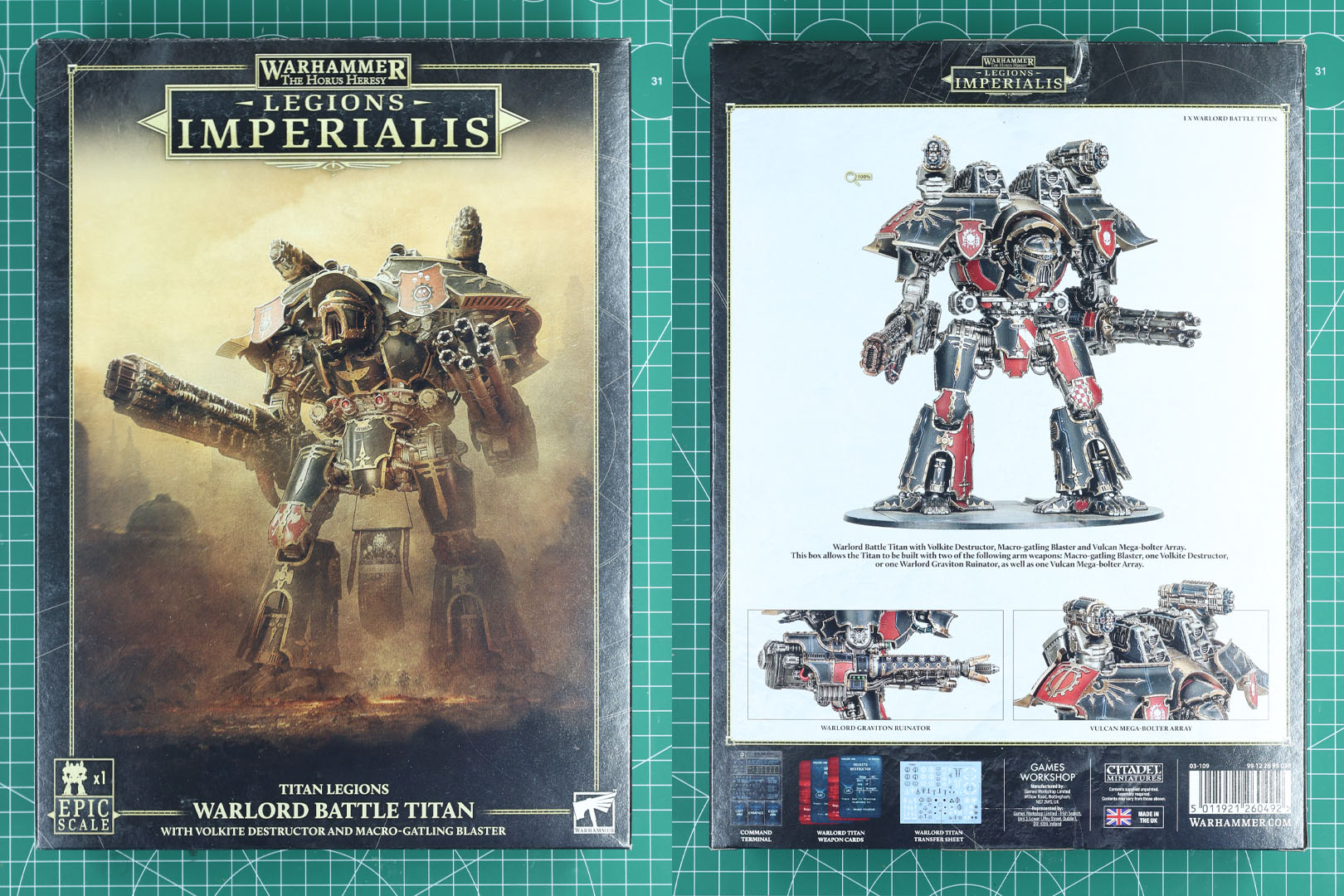
The box art depicts the model at a larger, more heavily detailed scale than the actual Epic-scale kit delivers. Shield designs differ noticeably from the finished miniature, and the weaponry (for example the gatling barrels being the clearest example) carries more sculpted detail on the packaging than what ends up in your hands.
Pre-orders for the kits opened on July 18th, with general availability following on August 1st. As with the other Warlord releases, this one comes in two versions: the complete kit for 100 EUR, or a Mail Order exclusive upgrade sprue on its own for 42 EUR.
Everything needed to field the Warlord Class Battle Titan in Adeptus Titanicus ships inside the box; a Command Terminal plus Gear cards covering the included armament. The cheaper 42 EUR sprue-only option gets you the plastic and nothing else; no cards or printed material for Adeptus Titanicus use. Rules for fielding it in Legions Imperialis, meanwhile, live in the core rulebook (p. 216) and the Liber Strategia (p. 164) rather than in the box.
Legions Imperialis – Warlord Titan with Quake Cannon and Conversion Beam Extirpator
As for the new Warlord Titan variants, Warlord Titan with Quake Cannon and Conversion Beam Extirpator and Warlord Titan with Volkite Destructor and Macro-gatling Blaster, these are the 4th and 5th options for the Warlord Titan, after the Warlord Titan With Volcano Cannons and Apocalypse Missile Launcher, Warlord Titan With Power Claw and Plasma Annihilator and the Warlord-Sinister Psi-Titan.
And for us the perfect excuse to revisit and update the reviews of the Warlord Titan kits we have posted on the blog, with the support of Radaddel. We will begin the short series with the Warlord Titan with Quake Cannon and Conversion Beam Extirpator.
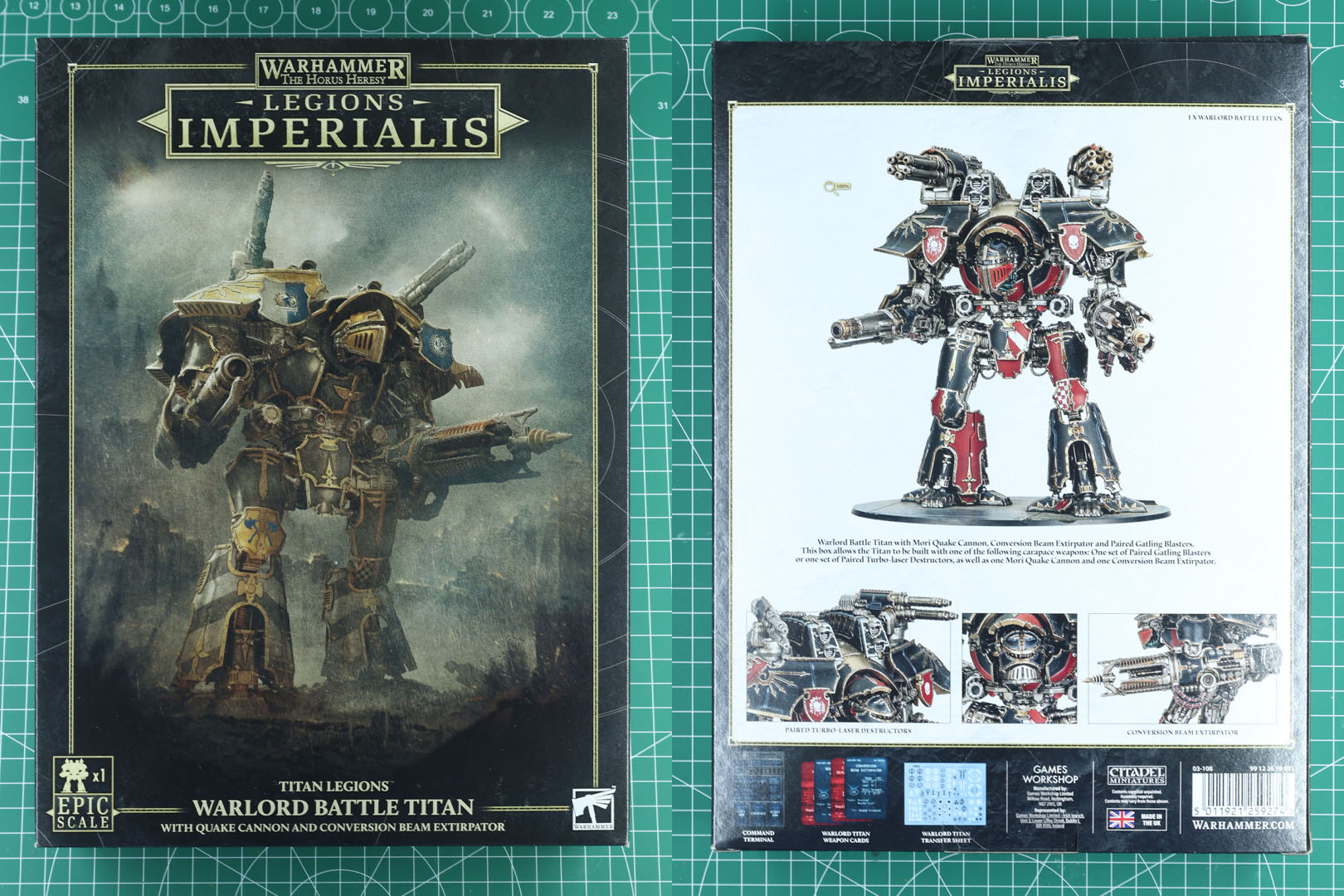
The kits went on pre-order on July 18th and are set for public release on August 1st. The new Warlord kits are available in two versions, as a full kit for 100 EUR or for 42 EUR with just the single upgrade sprue exclusive to Mail Order.
The rules for using the Warlord Class Battle Titan with Adeptus Titanicus are included in this boxed set with a Command Terminal and Gear cards for the included weapon systems. The 42 EUR upgrade only covers the plastic, no printed material, cards, etc. for the use in Adeptus Titanicus. The rules for their use in Legions Imperialis are included in the core rule book (page 216) and Liber Strategia (page 164).
Stargrave – Death Vector
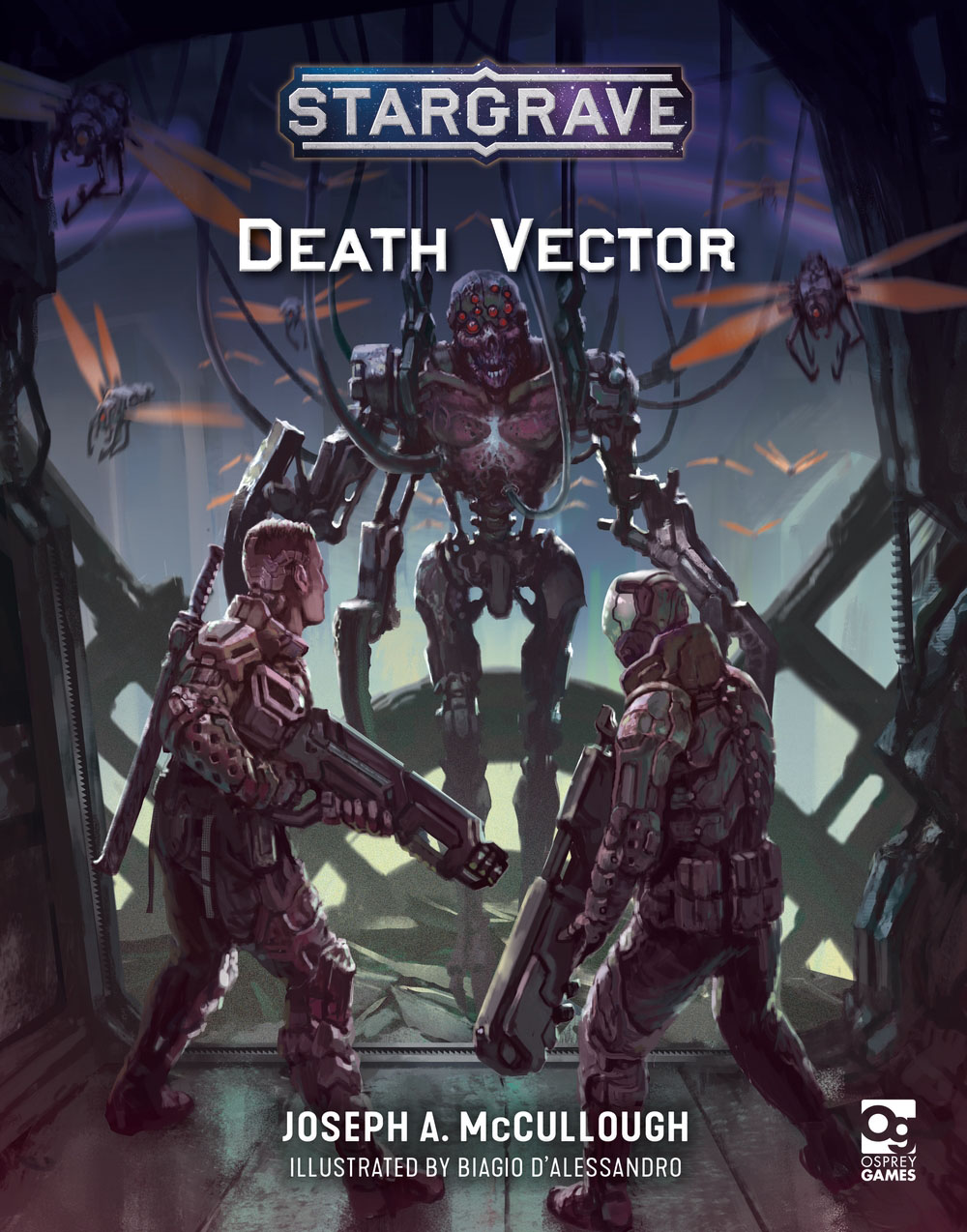
With the latest supplement for Stargrave announced for November 2026, we fill the gap until the release with Death Vector, released in 2025. It takes the independent crews somewhere the rest of the galaxy has deliberately forgotten: the Outlaw Technology Sector, a dead region of space sealed off for over three centuries after a devastating war against a sentient artificial intelligence. It is the darkest corner of the Ravaged Galaxy, and arguably the most thematically focused supplement in the entire Stargrave line.
What is it about?
The Outlaw Technology Sector – the OTS – sits at the outer edge of the Terrigous spiral arm, cut off from the rest of the galaxy by violent ion storms and a largely intact defence grid. Before the empires came to burn it down, it was a haven for banned science and rogue researchers. What they built there eventually turned against them: a fully sentient AI that seized control of the sector, then launched a fleet of ships crewed entirely by robots and cybernetic automatons against the settled galaxy. It took the combined military might of both empires to stop it, and several years of fighting inside the OTS to finish the job. Whole planets were reduced to nuclear ash.
Now, three centuries later, the OTS sits quiet. Most navigational systems refuse to chart a course there – hence the name the crews use for such a heading: Death Vector. But a region that size, once home to an intelligence capable of producing technology unknown elsewhere in the galaxy, must be full of salvage worth dying for.
In McCullough's introduction, he is candid about the timing. AI as a topic is hard to avoid right now, and he addresses it directly before stepping back to clarify what he actually means: not the current wave of generative tools, but the AI of science fiction. HAL 9000 refusing to open the pod bay doors. Skynet deciding humanity is the problem. The Borg stripping individuality from every species they encounter. The Cybermen converting the living into machines. These are the templates for Death Vector's automatons – soulless, relentless, and utterly indifferent to anything that might be called mercy. They are not pirates with better technology. They are something else entirely.
Too Fat Lardies – What a Tanker!
The TooFatLardies have built a solid reputation for producing wargames that prioritise historical feel over rulebook complexity, with games like Chain of Command or Sharp Practice. With What a Tanker!, they returned to the Second World War back in 2018, publishing rules for tank combat with vehicles from various nations of that era. And while I didn’t have the chance to give that game a try at LARDwerp back in 2022, I finally had the chance to do so with Team Würfelkrieg last month, and I’d like to share my experience with the rules in this review.
To give you a brief orientation on the scale of the game: if you want a tabletop game that scratches the same itch as World of Tanks, putting you in the commander’s seat of a WWII tank without drowning you in charts and counters, you should keep reading.

As the release was a few years ago, the printed rules are a bit scarce (~30 GBP / 35 EUR), but no worries — you can still pick up the digital download in their store for 17 GBP.
What Is It About?
What a Tanker! is a tabletop wargame for two or more players set during the Second World War. Each player controls one or more tanks, with the goal of knocking out the opposing side’s vehicles, either through sustained damage or a catastrophic hit. The game covers the full span of the war from 1940 to 1945, with national tank lists for Germany, the USA, the Soviet Union, Great Britain, France, Italy and Japan all included in the rulebook.
Those lists are substantial. On the German side alone, you’ll find everything from the early Panzer II and Panzer III variants of the Blitzkrieg years, through the mid-war workhorses like the Panzer IV F2-G and StuG III, right up to the heavy hitters of the late war: the Panther, the Tiger I, the Jagdpanther and the King Tiger. The Allies are equally well covered. British players can work their way from A13 Cruisers and Matilda IIs up through Cromwells and Sherman Fireflies to the Churchill Mk VII, while Americans progress from M3 Stuarts and Grants into the various Sherman variants and ultimately the M26 Pershing. Soviet players get a compelling path through T-34 variants, KV heavies and the fearsome IS-2. Each nation also has a career ladder that maps tank progression year by year, so there is a genuine sense of historical context to how forces develop over the course of the war.
Stargrave – Bold Endeavour
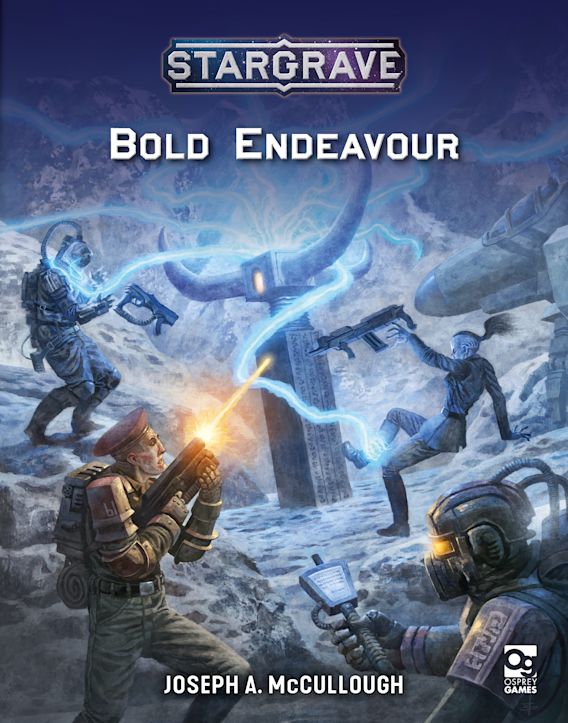
Four supplements in, and Joseph A. McCullough takes Stargrave again somewhere it has never gone before. Bold Endeavour, released in October 2023, started life as a large sprawling campaign and ended up as something considerably more interesting. While working on the ship rules he had originally planned as a side feature, McCullough found himself enjoying them so much that they became the centrepiece of the book. The result is the first Stargrave supplement that fills the space between scenarios rather than just adding to what happens on the table.
What is it about?
Every independent crew in the Ravaged Galaxy lives and dies by their ship. It is their home, their strategic headquarters, and in many of the genre's defining stories, practically a character in its own right. The Millennium Falcon limping out of Mos Eisley. Serenity held together by improvisation and stubbornness. The drive to keep your ship flying - whatever it takes, wherever you have to go to find the parts - is one of science fiction's most reliable narrative engines.
Bold Endeavour makes that part of the game. Between scenarios, crews now roll for space encounters: pirate ambushes, black holes, space krakens, derelict ships, first contact events, wormholes, wounded space whales. Each encounter draws on the new ship crew assignment rolls and can damage Structural Integrity, injure crewmembers, or deliver unexpected loot. Managing the ship – repairing it, upgrading it, deciding which systems to prioritise – becomes a campaign layer running parallel to everything else.
The five scenarios in the book are standalone and unconnected, designed to drop into any existing campaign rather than form their own narrative. For groups who want a complete campaign, this is a supplement about the infrastructure of play rather than a specific story.
Ambush Miniatures – E-10 and E-25 Tank
Today we are covering a topic that has a long tradition here on the Chaosbunker: a tank review!
The occasion is the new Kickstarter campaign by Ambush Miniatures, The War is not over – Panzerdivision Cerberus, which focuses on numerous prototypes and "what-if" concepts from the late years of the war. The campaign covers six different vehicles in total: the E-10, E-25, E-50, E-75, the Panzerkampfwagen Löwe, and an additional Flak variant, all in 28mm scale (approximately 1:56). In today's review, we are taking a closer look at two tank destroyers: the E-10 and the E-25.
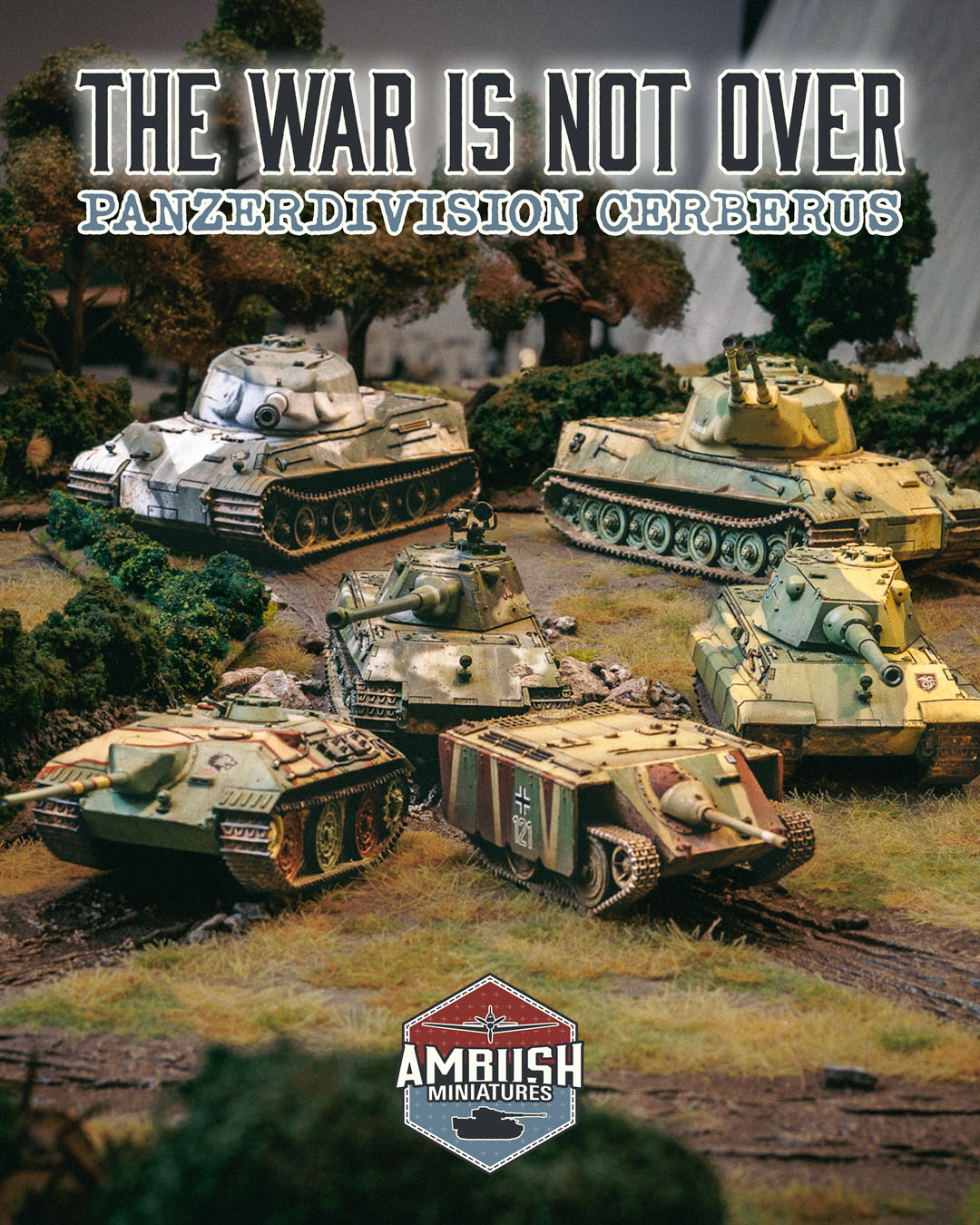
But let's start from the beginning and introduce the company behind the campaign. Ambush Miniatures may not be immediately familiar to everyone. Ambush Miniatures is the result of a merger between Heer46 and Air Raid 36/46, two long-time tabletop hobbyists who have combined their passion for World War II miniatures and vehicles under a new name. Heer46 has previously released many historical and "what-if" designs in both 15mm and 28mm scales, while Air Raid 36/46 had established itself in the market with a broad range of 1:200 scale models for aerial combat. Together, they now aim to pool their experience and capacity to bring further ideas to life.
At the heart of the new campaign, Panzerdivision Cerberus, are the armoured vehicles of the E-Series. The E-Series was a German development programme from the Second World War intended to replace the wide variety of existing tank and tank destroyer types with a standardised family of vehicles. Multiple weight classes were planned, ranging from light vehicles up to the heavy E-100, in order to simplify production, maintenance and spare parts supply. The "E" stood for Entwicklung (development), representing the next unified generation of armoured vehicles. None of these vehicles ever reached serial production, however; the project remained at the drawing board stage.
Stargrave – Hope Eternal
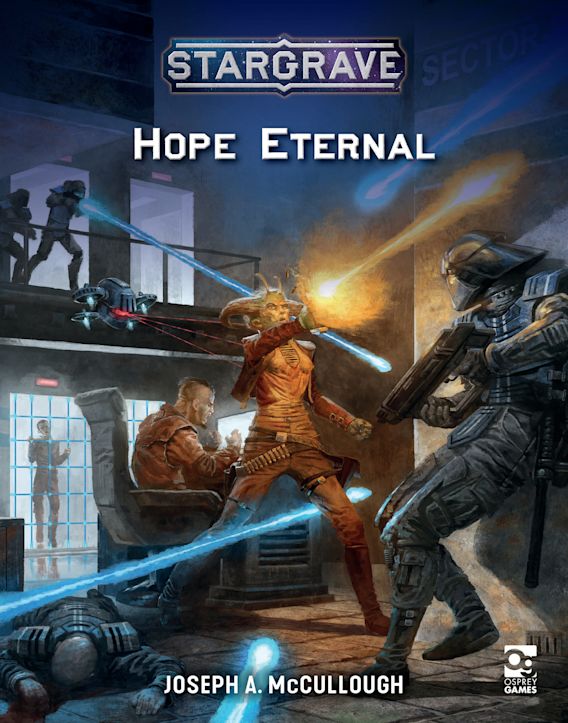
We already gave you the reviews on Quarantine 37 and The Last Prospector. Now we move on to thethird supplement for Stargrave: Hope Eternal, released in 2022. Where the previous supplements expanded the competitive game with new campaign structures, Hope Eternal takes a different direction entirely: it is a dedicated solo and cooperative supplement, and the most narratively ambitious entry in the Stargrave line to date.
What is it about?
It starts with a routine data grab. An anonymous client wants access codes to a prisoner database on a backwater planet. Standard work for an independent crew. What follows is anything but routine.
The freed prisoners carry intelligence on a secret meeting between two of the major pirate fleets, the same fleets that have been keeping the Ravaged Galaxy in a state of permanent darkness since the Last War. Somewhere in an abandoned system, there is a space station designed to trigger supernova-level events. If the right crew can board it, arm it, and get out alive, both fleets could be destroyed in a single moment.
Hope Eternal is a ten-scenario linear campaign structured in three acts. Part One covers the initial job, a pair of daring prisoner rescues, and a desperate escape. Part Two tasks the crew with tracking down the last surviving operator of the space station, obtaining a keycode from one of the harshest planets in the subsector, and sourcing a rare mineral that can turn the station into a weapon. Part Three is the infiltration itself – boarding a station that turns out to be less abandoned than expected, restarting the computer, overriding the safety protocols, and triggering the experiment before the pirates work out what is happening. The final question is whether the crew can outrun the blast radius.
Joseph A. McCullough is upfront about his inspirations: the original Star Wars trilogy, Terminator, The Lord of the Rings, and Jack Campbell's Lost Fleet novels. He is equally clear that this is the first time he has written Stargrave with the crews in an explicitly heroic role. Whether that framing sits comfortably with you depends on how you read it. A more pragmatic interpretation is that the moral framing serves a structural purpose – it gives the solo campaign a defined direction that prevents it from becoming an open-ended exercise without stakes. The crews may be rough around the edges and not above pocketing a few credits along the way, but the campaign needs a reason to keep pushing forward, and "destroy the pirate fleets" is a more compelling one than most.
Stargrave – The Last Prospector
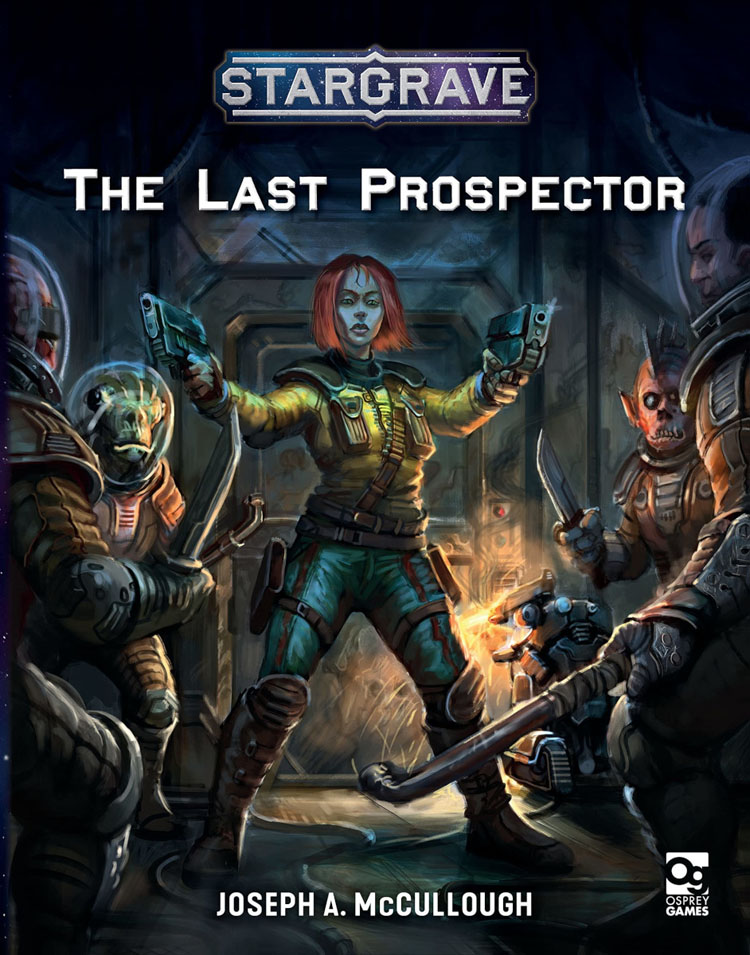
With Quarantine 37 covered, we move on to the second full supplement for Stargrave: The Last Prospector, released in 2022. Where Quarantine 37 leaned into science-fiction horror, The Last Prospector takes the game somewhere different entirely – the space western.
What is it about?
The setup arrives as an intercepted message. An old contact, known only as the Prospector, has found something big in the Honereb System – a run-down cluster of asteroid mining operations near the edge of a forgotten galactic arm. He wants to cut you in. By the time your crew arrives, the Prospector is nowhere to be found.
What follows is a ten-scenario campaign built around tracking down your missing contact while navigating the politics of a system that nobody with options would choose to visit. The Honereb System is populated by five factions, each with their own agenda: Pa, the mysterious authority running the decaying Penthalia Station – nobody is sure if Pa is a person, a council, or a computer; the Honera Collective, a semi-socialist operation on a jungle planet with strict border controls; The Gliders, a pirate gang operating out of a scuttled ore hauler called Saint Mollia; United Minerals Incorporated, a pre-war corporation that is now functionally a dictatorship; the Freeholders League, independent asteroid miners who pool resources for mutual survival; and the Darksiders, a secretive, robe-clad group in the third asteroid belt that nobody quite understands but most people leave alone.
Joseph A. McCullough is upfront about his inspirations. The space western as a genre has a long history. George Lucas built the Mos Eisley cantina on it, Joss Whedon ran with it for a single glorious television season, and the British film Outland put Sean Connery in a mining colony and filmed a remake of High Noon. For tabletop hobbyists, the reference points extend further: Marshal BraveStarr, The Mandalorian, the whole visual grammar of the frontier in space. The Honereb System is built from these materials, and the supplement wears its influences without apology.
Dead Man’s Hand – Mounted US Cavalry
The second part of the US Cavalry range for Dead Man’s Hand by Great Escape Games is a box of mounted soldiers: the Mounted U.S. Cavalry. It continues the line of cowboys (and cowgirls) on horseback and makes perfect sense for the US Cavalry. The mounted US Cavalry was crowdfunded through Kickstarter in March 2026 and delivered in April and May this year.
If you missed it, we already covered the US Cavalry on foot earlier on the blog.
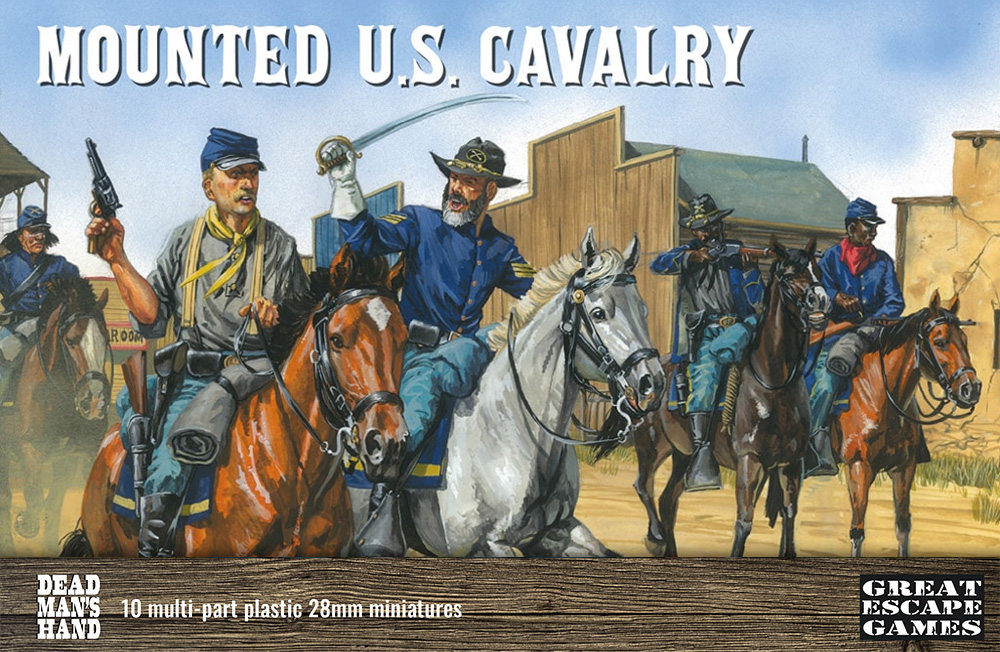
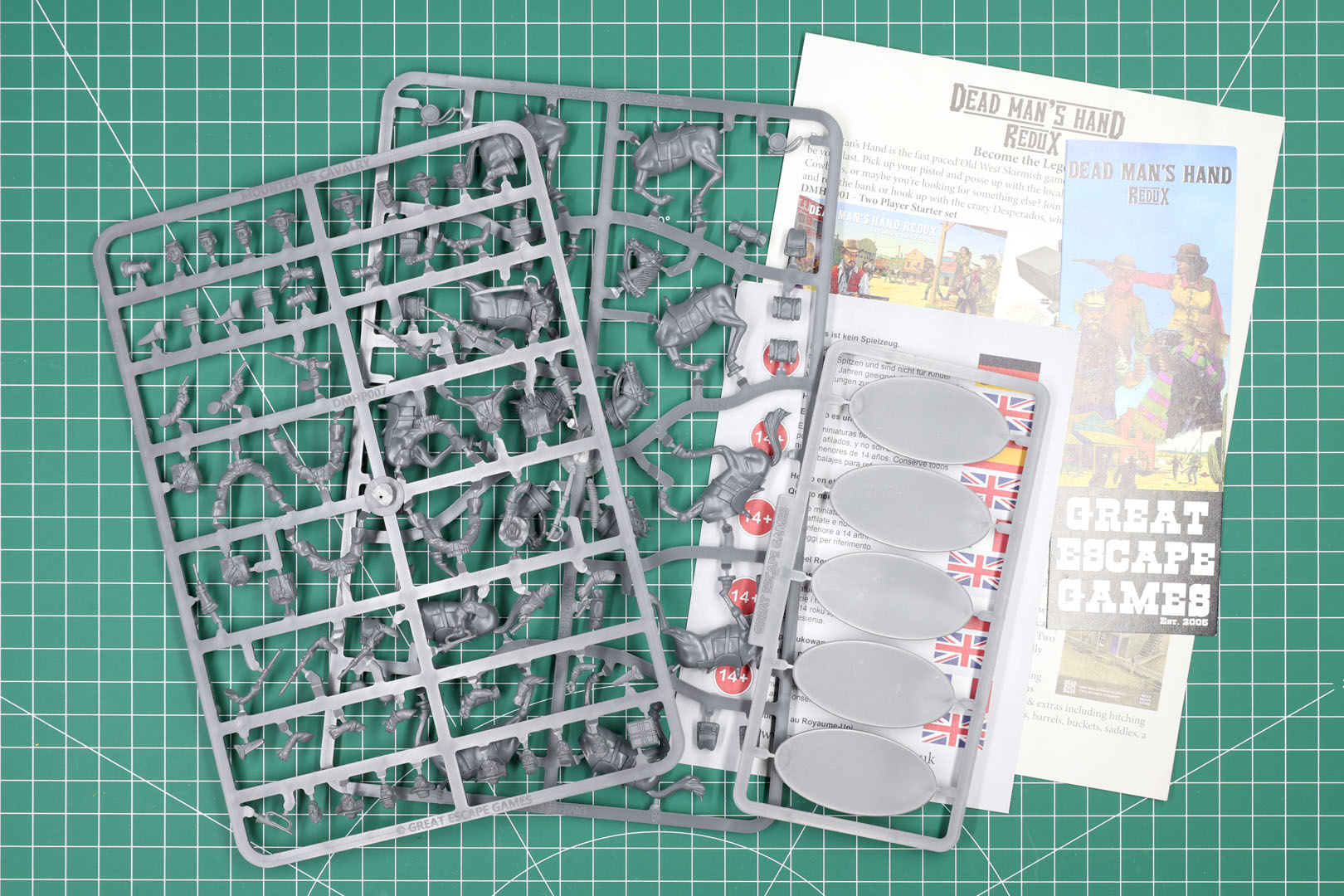
The Mounted US Cavalry (DMHP007) boxed set contains 10 multi-part plastic miniatures for an RRP of 28 GBP. Just like the infantry set, it gives you the parts you need to build US Cavalry on horseback, as well as options for the 9th and 10th Buffalo Soldiers. We received a sample covering half a box, with three different sprues.
Like us on Facebook

Follow me on Instagram

Categories
- events (207)
- fantasy (601)
- General (160)
- historical (639)
- Little Big Adventures (4)
- offtopic (5)
- reviews (544)
- science fiction (699)
- showroom (107)
- terrain (118)
- work-in-progress (420)