Warhammer Colour – Part 1
I wrote this article in 2019 when the Contrast paints came out. Since then, so much has happened on the Games Workshop paint rack that an update was overdue: far more Contrast colours, reformulated Shades and, since March 2026, a new name for the whole range: Warhammer Colour.

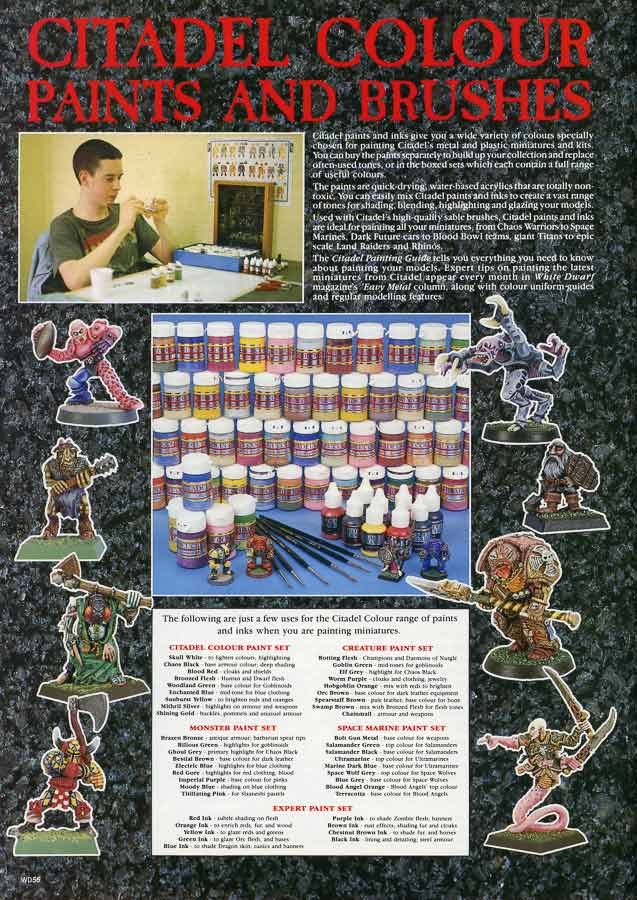
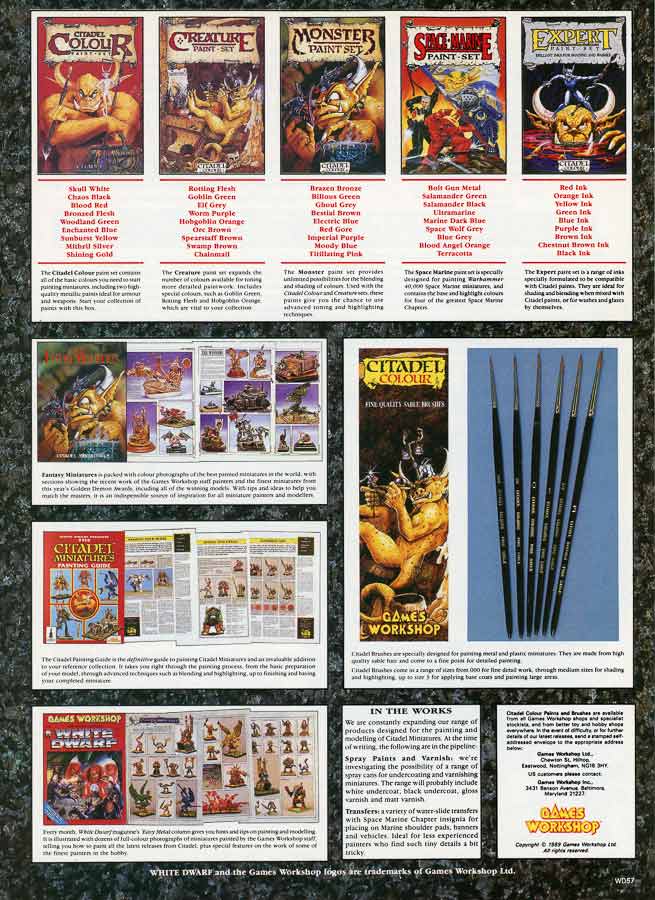
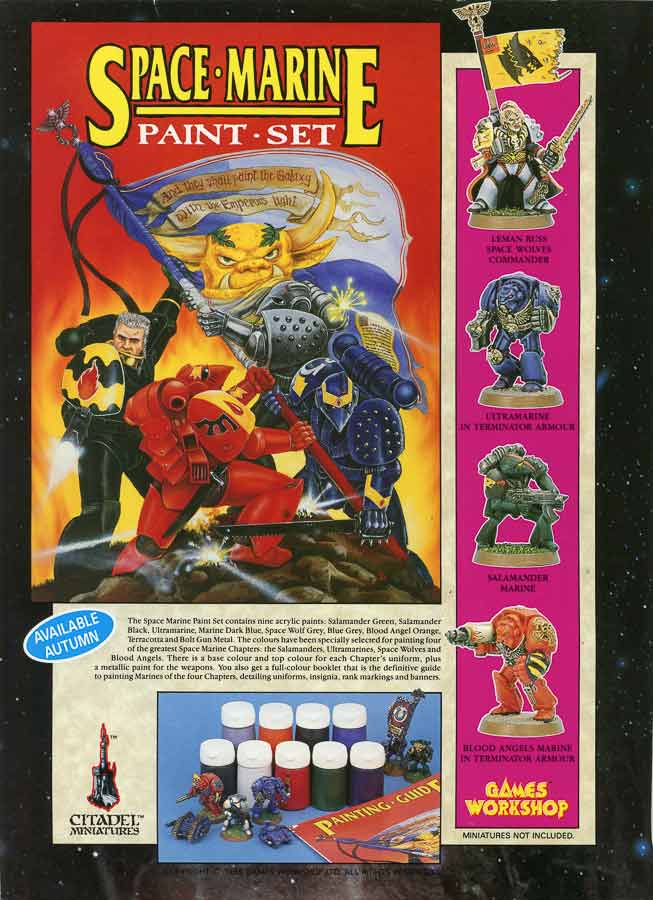
The Citadel name has been with Games Workshop since the early days, when the company was more of a publisher and distributor than a miniatures manufacturer. The label covered miniatures (back then alongside Marauder and a few other ranges), but also paints and brushes. Glazes, Technicals and the like were still a long way off, yet those first paint pots left as much of a mark on many of us as the metal miniatures themselves.
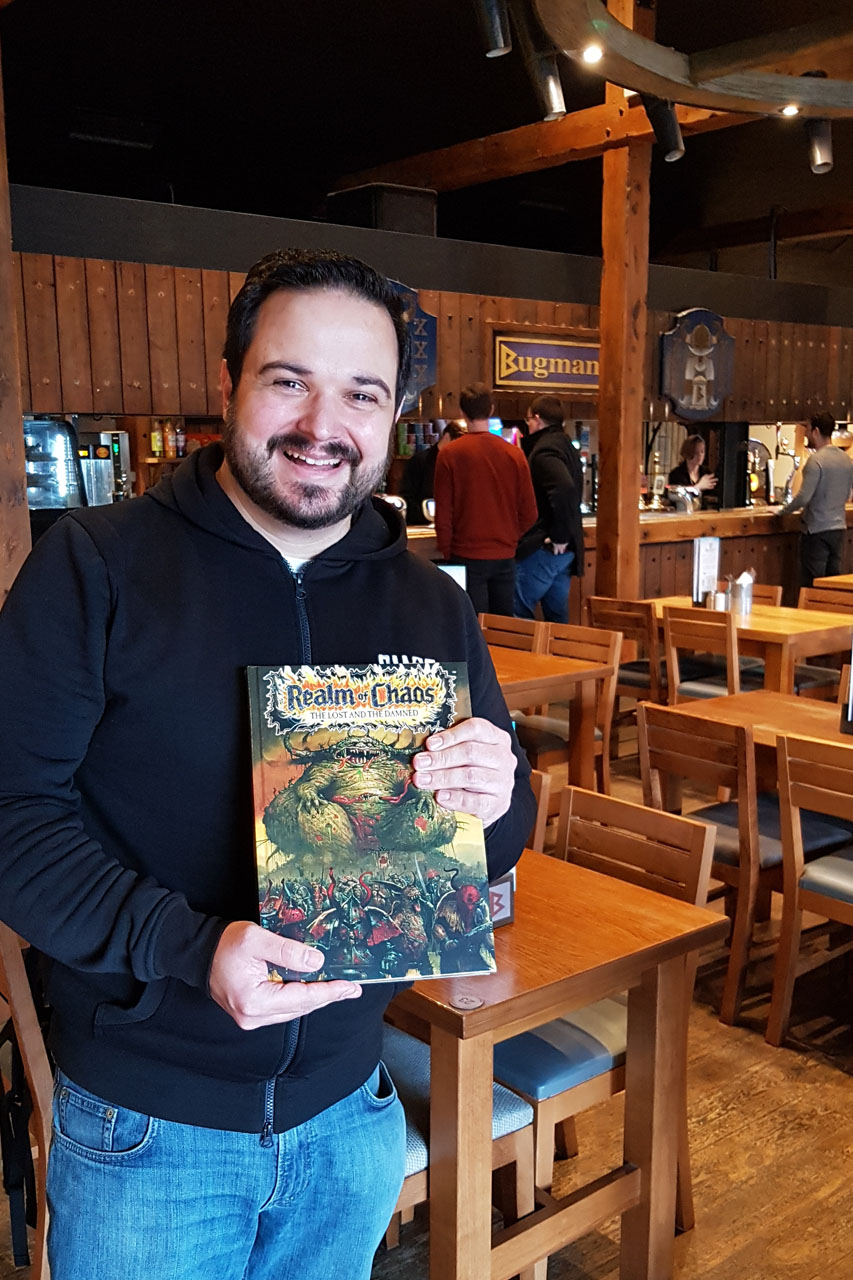
If you're interested in the early days, there's no way around Mike McVey, who shaped the painting studio and 'Eavy Metal like few others. Realm of Chaos 80s has a great interview with him, which also shows the very first Citadel paints in their tall, round pots. That pot shape lives on to this day with Coat d'Arms. You'll often read that Coat d'Arms made the Citadel paints back then. That's not quite right: they were produced by HMG Paints in Manchester, and Black Hat Miniatures later took over the formulas from that era for their own Coat d'Arms range. If the pots look familiar even though you weren't around at the time, that's because Privateer Press used the same design for their P3 range, and so did Wargames Foundry.
Warhammer Fantasy – Through the Ages Part 1
As the article on Warhammer 40k through the ages was so popular, I decided to write something similar on Warhammer Fantasy. Actually this draft has been sitting on my desk for a while now, and I finally pulled through to finish it.
On November 15 of 2019 an article on Warhammer Community created a lot of buzz - Old World? New Warhammer! With a teaser the day before on social media, everything comes round again, even squares.
The post announced the return of the Old World of Warhammer Fantasy, a game system and lore that had been discontinued in 2015 with the End Times and replaced by the new brand of Age of Sigmar. But why was this the case? For that, we have to go back to where Warhammer Fantasy started. It is quite the journey, so I split it into two parts: part one covers Warhammer Fantasy Battles from 1983 to the End Times, part two covers Age of Sigmar and the return of The Old World.

1983 Warhammer - The Mass Combat Fantasy Role-Playing Game (1st Edition Logo)
The first edition of Warhammer was released in 1983. The idea behind it was to create a rule set, which made it possible for role players to use their miniatures in skirmishes and mass combat. There are multiple books on the origins of Games Workshop and Citadel Miniatures, for example Dice Men or Talking Miniatures, but to put it briefly Games Workshop was a distributor of role playing games and Citadel Miniatures a company that produced Ral Partha miniatures under license in the UK until 1984 and their own unique ranges as well. To promote sales of these miniatures set of rules was needed and Rick Priestley and Richard Halliwell, who wrote the Reaper Fantasy Wargame Rules in the late 70s, would be the authors of the first edition of Warhammer, together with Bryan Ansell.
Warhammer Fantasy – Through the Ages Part 2
In part one we followed Warhammer Fantasy Battles from three little booklets in a white box in 1983 to the End Times, when Games Workshop did the unthinkable and destroyed its own world. But the story didn't end there. It split into two paths: Age of Sigmar, the new game that replaced Warhammer Fantasy in 2015, and The Old World, which brought regiments and square bases back in 2024. So let's pick up where we left off.

2015 Warhammer - Age of Sigmar
All of this was answered in July 2015 with the release of Warhammer - Age of Sigmar. The regiments were gone, square bases were gone, the lore was gone ... well, altered and "further" developed. In the beginning there weren't even points. Balance was left to scenarios and sudden death conditions for uneven armies, until the General's Handbook introduced matched play points in 2016. The game was more of a platoon sized skirmisher, than the mass combat experience of Warhammer Fantasy Battles. But that was the point, the world had changed. Games Workshop transferred a lot of the experience they made with 40k towards their new fantasy universe.
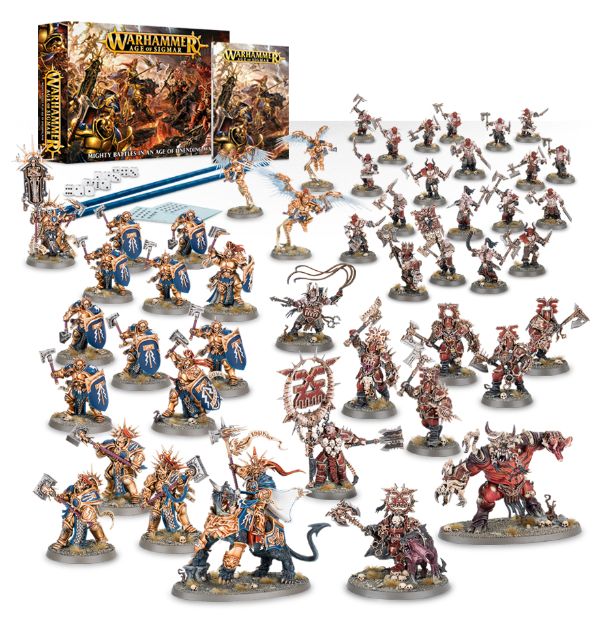
2015 Warhammer Age of Sigmar - 1st Edition Launch Box
The first starter set pitted the Stormcast Eternals against the Khorne Bloodbound. The core rules came on just four pages and were free to download, square bases became round, and army books were replaced by warscrolls – one profile per unit with everything you need. An idea that 40k adopted two years later with the datasheets of its 8th edition.
Warhammer 40,000 – Space Marine Scouts
Following our look at the Space Marine Terminators for a 2nd edition project, we continue the series with another unit that defined the era: the Space Marine Scouts. Less celebrated than their Terminator-armoured brothers, they were nevertheless a staple of any 2nd edition Space Marine army and a unit with a more convoluted release history than most people remember.
To bring you up to speed on what that means in design terms, this artwork by Dave Gallagher for the Tyranid Attack rulebook, a supplement for Advanced Space Crusade, shows the very distinct and rather different design with which Space Marine Scouts entered the world of Warhammer 40,000.
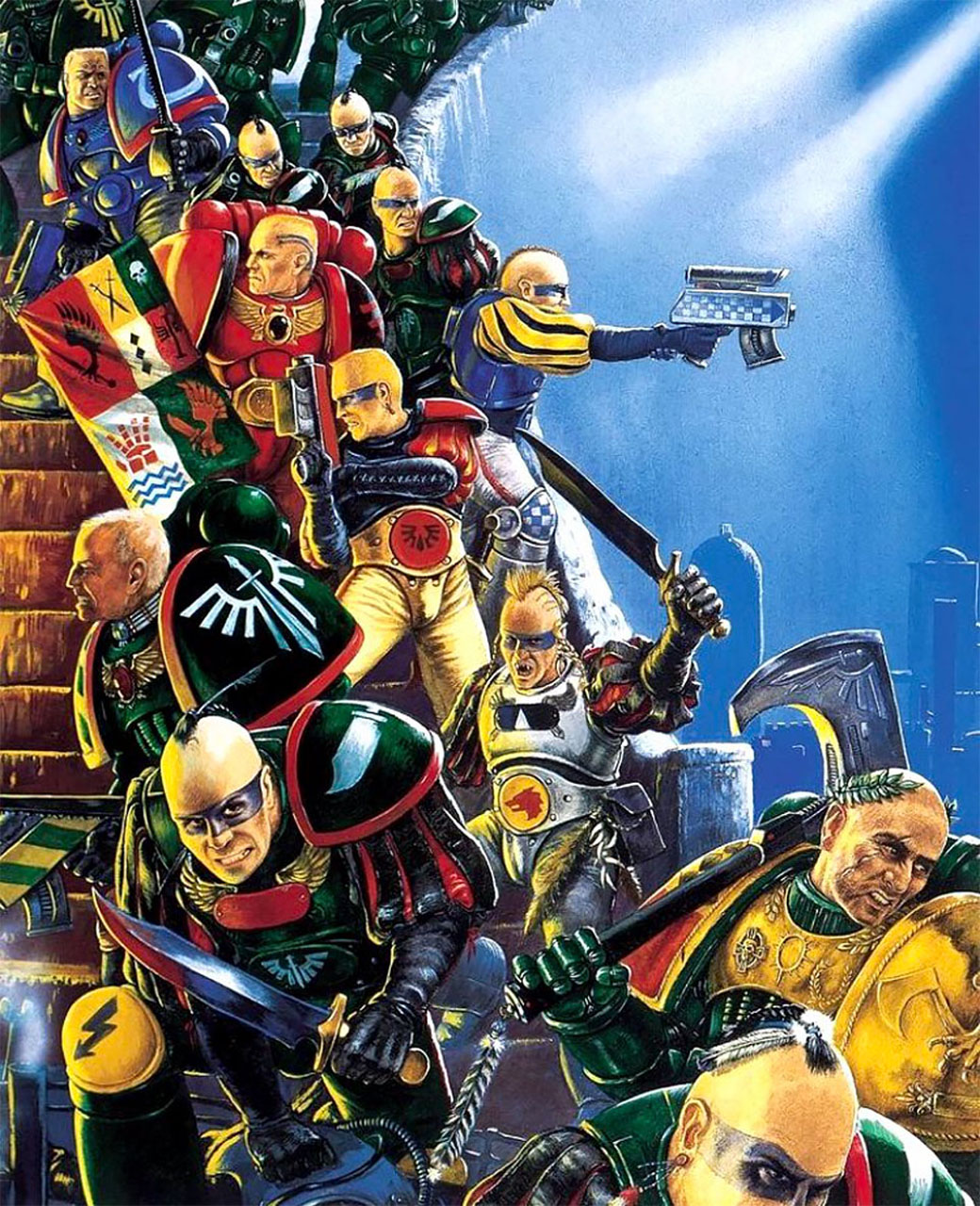
As with the Terminator article, this one focuses on identifying and sourcing the right miniatures for an era-appropriate project. How to implement them in the Imperial Fists will follow in a separate article.
Legions Imperialis – Reaver Titan with Graviton Obliterator and Volkite Annihilator
This new Reaver Titan with Graviton Obliterator and Volkite Annihilator is the third boxed variant of a Reaver Titan, after the Reaver Titan with Gatling Blaster, Laser Blaster, Power Fist and Carapace Apocalypse Missile Launcher, and the Reaver Titan with Melta Cannon, Chainfist and Carapace Turbolaser Destructor.
With this box, we conclude our brief series on the latest releases for Legions Imperialis and Adeptus Titanicus, thanks again to our sponsor Radaddel.
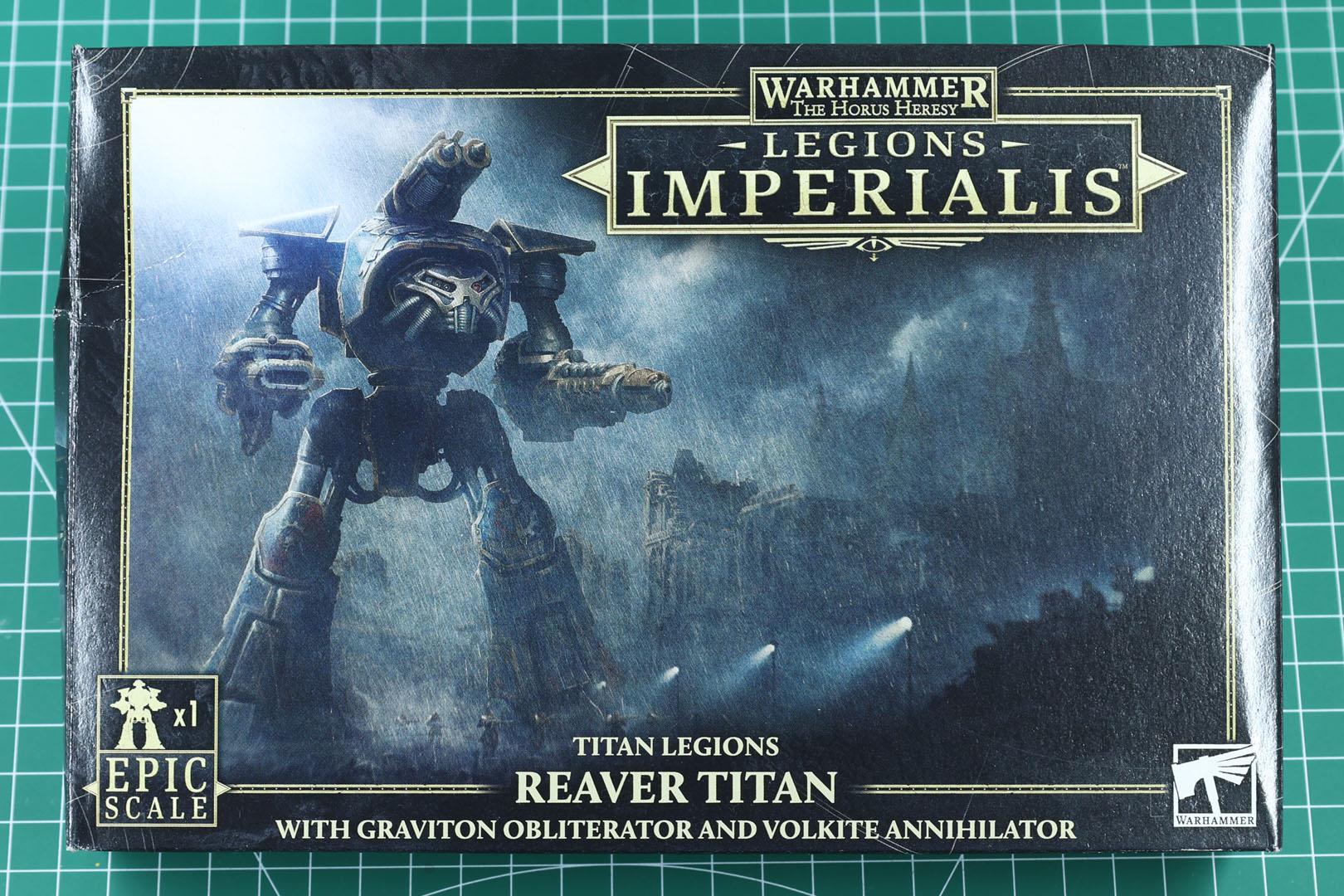
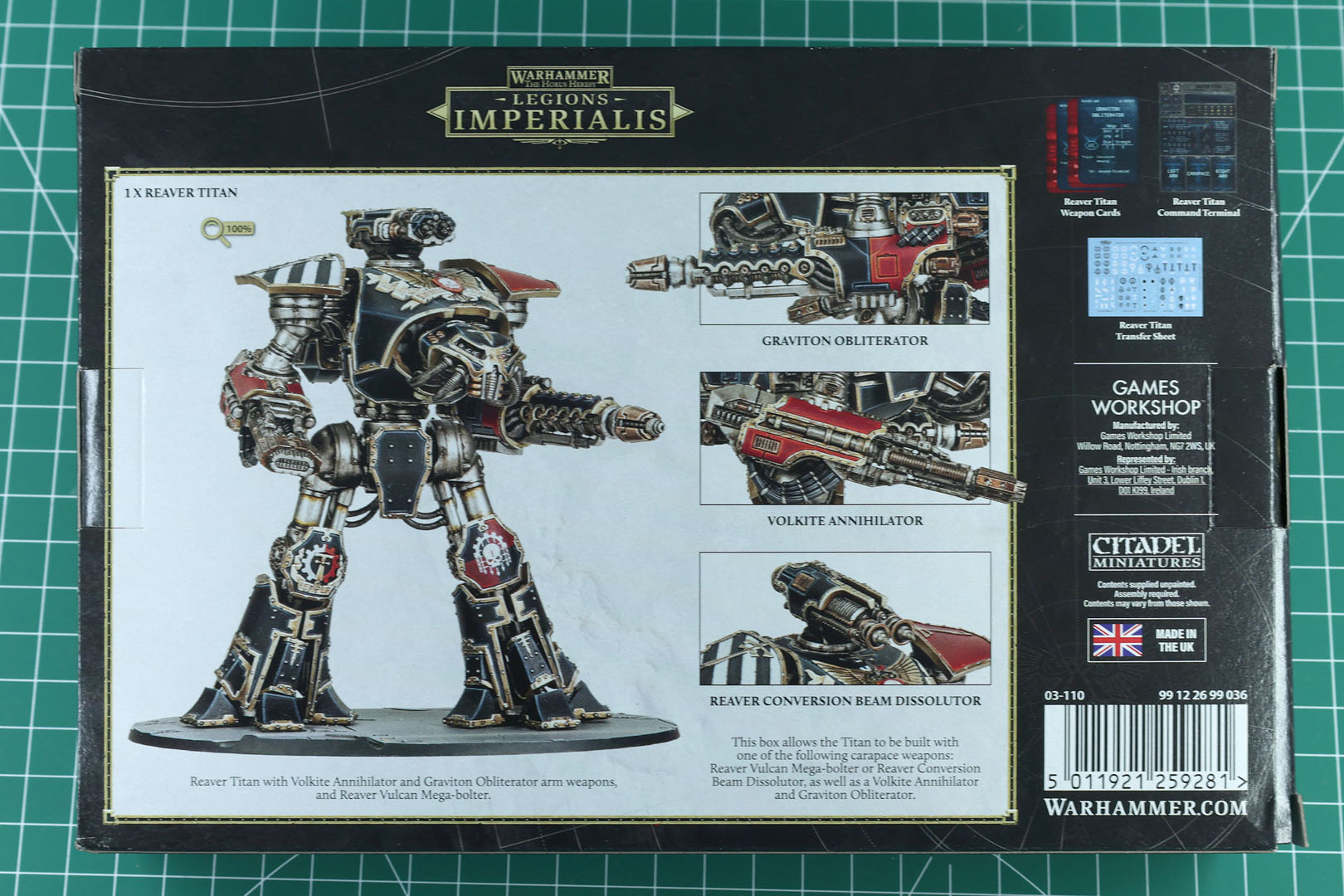
Just like the two other kits, the pre-order for the Reaver was opened on July 18th, with public release on August 1st. The new options in plastic are either available as a full kit for 51,50 EUR or just the Mail Order exclusive sprue for 23 EUR.
The boxed set provides everything you need to use the Reaver Titan in Adeptus Titanicus right inside the box: a Command Terminal plus Weapon cards covering the included armament. The sprue-only upgrade only covers the plastic and nothing else. The rules for using it in Legions Imperialis are covered in the core rulebook (p. 214) and the Liber Strategia (p. 162) rather than in the box.
Legions Imperialis – Warlord Titan with Volkite Destructor and Macro-Gatling Blaster
Among the freshly released Warlord Titan variants, the Warlord with Volkite Destructor and Macro-Gatling Blaster sits alongside its sibling kit, the Warlord with Quake Cannon and Conversion Beam Extirpator, as options four and five for the chassis. Joining the existing line-up of the Warlord with Volcano Cannons and Apocalypse Missile Launcher, the Warlord with Power Claw and Plasma Annihilator, and the Warlord-Sinister Psi-Titan.
We use this release to revisit and update the reviews of the Warlord Titan with the support of Radaddel, and cover today the second new Warlord Titan kit, with Volkite Destructor, Macro-Gatling Blaster and Graviton Ruinator.
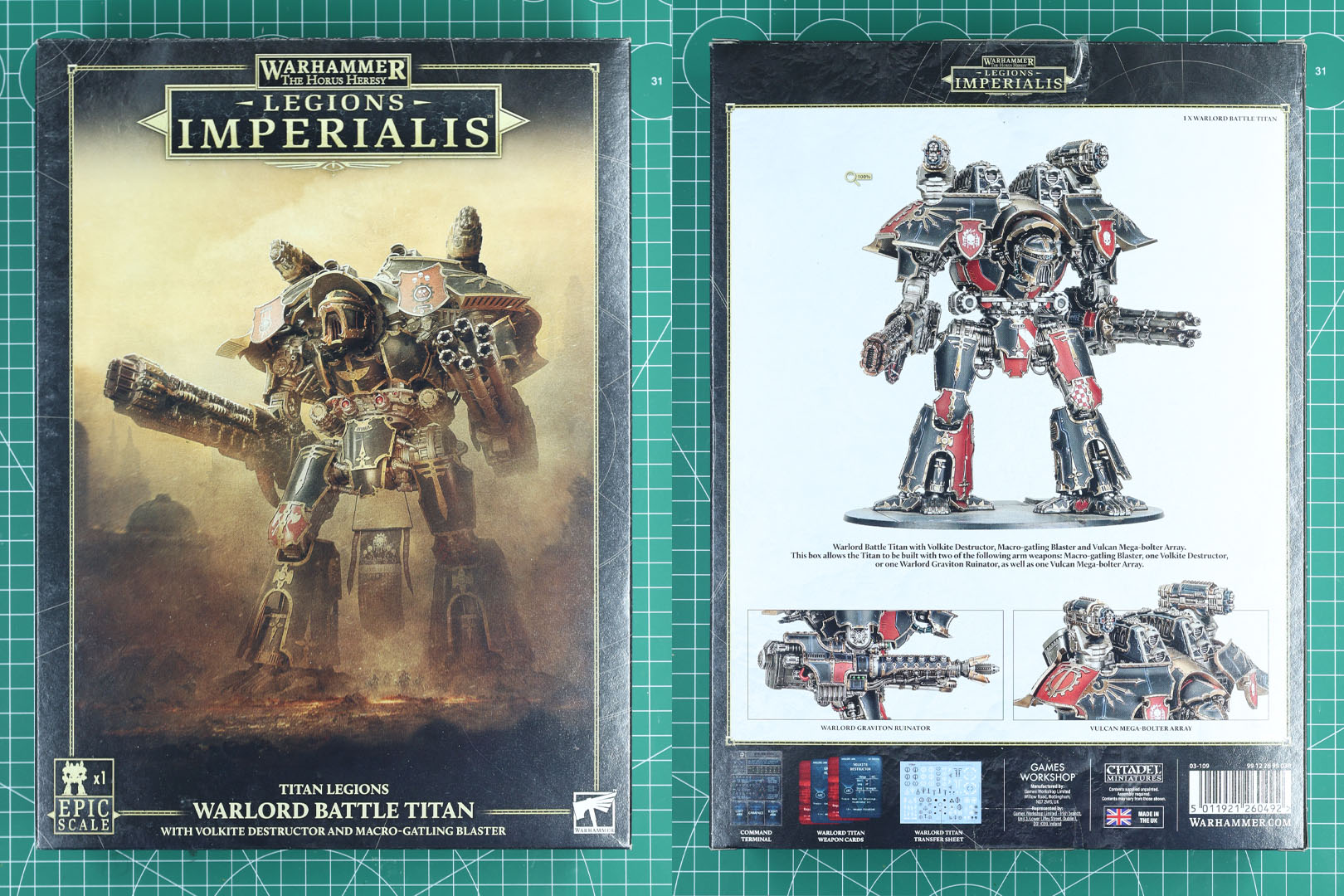
The box art depicts the model at a larger, more heavily detailed scale than the actual Epic-scale kit delivers. Shield designs differ noticeably from the finished miniature, and the weaponry (for example the gatling barrels being the clearest example) carries more sculpted detail on the packaging than what ends up in your hands.
Pre-orders for the kits opened on July 18th, with general availability following on August 1st. As with the other Warlord releases, this one comes in two versions: the complete kit for 100 EUR, or a Mail Order exclusive upgrade sprue on its own for 42 EUR.
Everything needed to field the Warlord Class Battle Titan in Adeptus Titanicus ships inside the box; a Command Terminal plus Gear cards covering the included armament. The cheaper 42 EUR sprue-only option gets you the plastic and nothing else; no cards or printed material for Adeptus Titanicus use. Rules for fielding it in Legions Imperialis, meanwhile, live in the core rulebook (p. 216) and the Liber Strategia (p. 164) rather than in the box.
Legions Imperialis – Warlord Titan with Quake Cannon and Conversion Beam Extirpator
As for the new Warlord Titan variants, Warlord Titan with Quake Cannon and Conversion Beam Extirpator and Warlord Titan with Volkite Destructor and Macro-gatling Blaster, these are the 4th and 5th options for the Warlord Titan, after the Warlord Titan With Volcano Cannons and Apocalypse Missile Launcher, Warlord Titan With Power Claw and Plasma Annihilator and the Warlord-Sinister Psi-Titan.
And for us the perfect excuse to revisit and update the reviews of the Warlord Titan kits we have posted on the blog, with the support of Radaddel. We will begin the short series with the Warlord Titan with Quake Cannon and Conversion Beam Extirpator.
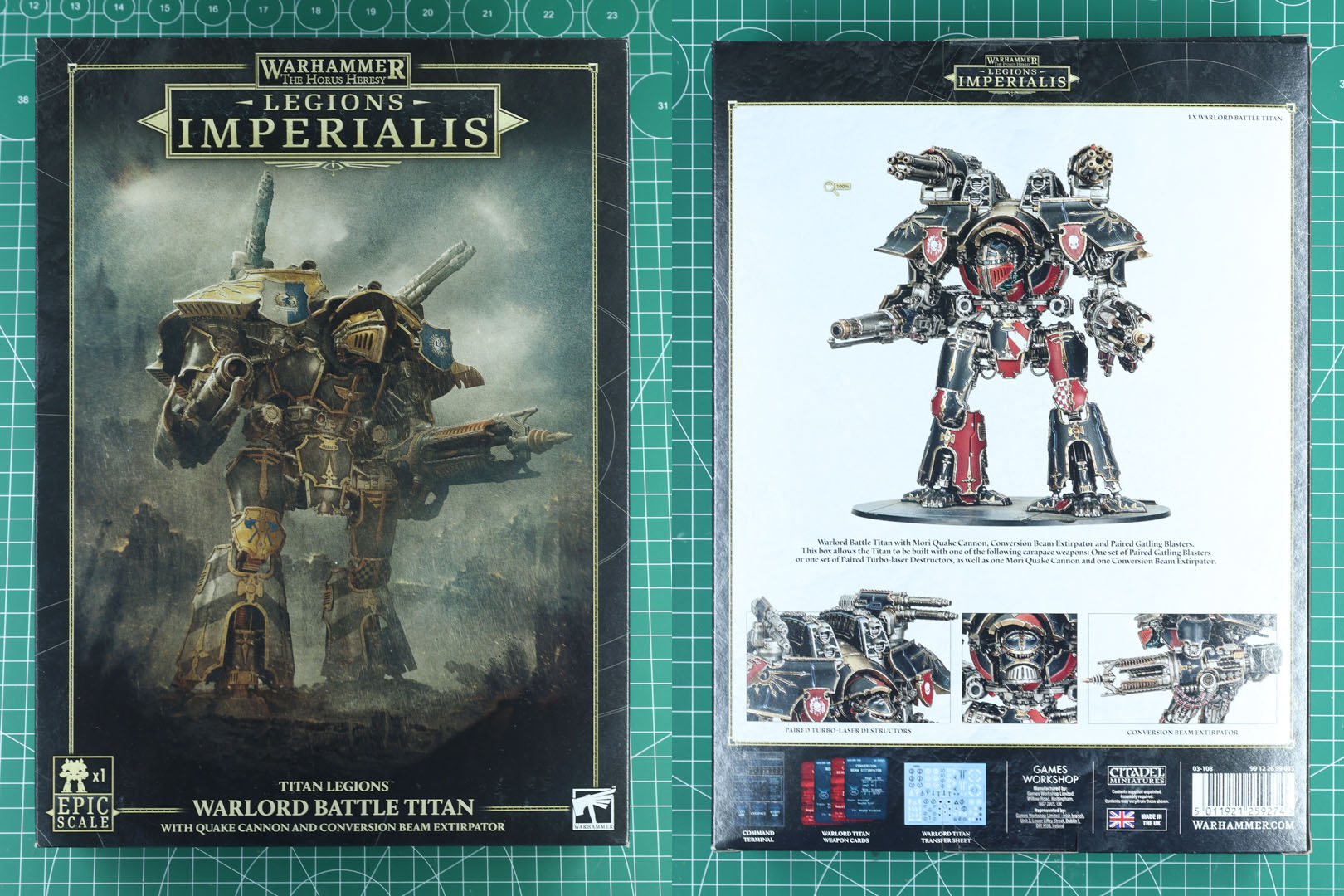
The kits went on pre-order on July 18th and are set for public release on August 1st. The new Warlord kits are available in two versions, as a full kit for 100 EUR or for 42 EUR with just the single upgrade sprue exclusive to Mail Order.
The rules for using the Warlord Class Battle Titan with Adeptus Titanicus are included in this boxed set with a Command Terminal and Gear cards for the included weapon systems. The 42 EUR upgrade only covers the plastic, no printed material, cards, etc. for the use in Adeptus Titanicus. The rules for their use in Legions Imperialis are included in the core rule book (page 216) and Liber Strategia (page 164).
Age of Sigmar Spearhead – City of Ash
Games Workshop sent us the City of Ash boxed set, the latest entry in their Spearhead format for Age of Sigmar. It is the first Spearhead set we review on this blog, and we will do an unboxing review for City of Ash in a similar way to how we covered the Kill Team sets. But just to point out: Spearhead is not comparable to Kill Team (of which the Fantasy counterpart is Warcry), but rather to 40k’s Combat Patrol game mode.
City of Ash is a themed boxed set for the Spearhead game mode: a self-contained two-player set designed for fast, focused games. There is also a regular variant, based on the last Age of Sigmar starter set containing Stormcast Eternals and Skaven.


What is it about?
The name says it all: Embergard, the City of Ash. A dead city fought over for its reserves of emberstone, a magical resource with military significance in the ongoing wars of the Mortal Realms. Two Spearhead-warbands clash in its ruins: the Freeguild soldiers of the Cities of Sigmar under the command of Jorvan Kreel, and the Clans Eshin Skaven, rat-folk assassins led by the notorious Deathmaster Crixxit.
Warhammer 40,000 – 2nd Edition Dark Millenium Expansion Set
A year later after the release of Warhammer 40k's 2nd edition, in 1994, a large boxed expansion was released, as was common for Games Workshop systems in the '90s, to add more gear, psychics and vehicles to the game. Just as we did with the starter set, we want to include this unboxing in our coverage as a guideline or checklist for your collection.


These supplements usually covered card decks and advanced rules, but never miniatures. Dark Millenium did the same for Warhammer 40,000, adding almost 100 cards for the sci-fi magic called psi, 24 vehicle datasheets, and lots of new gear for all kinds of armies. It also came with a 48-page rulebook.
Warhammer 40,000 – 2nd Edition Starter Set
Today, we will provide an overview of the contents of the 2nd Edition Starter Set of Warhammer 40,000 (1993–1998) for collectors and those about to enter the realm of retro-gaming. You can use this article as a checklist to see if your set is complete, or to identify any missing items.


This edition was accompanied by White Dwarf (UK) issues 166 to 225, Citadel Journals 1 to 28, various codices, and a supplement called Dark Millennium (which we will also cover).
Like us on Facebook

Follow me on Instagram

Categories
- events (212)
- fantasy (611)
- General (162)
- historical (649)
- Little Big Adventures (4)
- offtopic (5)
- reviews (554)
- science fiction (714)
- showroom (108)
- terrain (119)
- Uncategorized (1)
- work-in-progress (423)