Konflikt ’47 – 2nd Edition Core Rules
Werewolves, vampires and the walking dead on the battlefields of World War 2: the Weird War genre has been around for a long time, and I have always had a soft spot for it. Long before Konflikt '47 officially existed, I wrote my own alternative history for my Bolt Action force, in which my Wehrmacht platoon is led by a vampire, and my first zombies were converted from early German Bolt Action infantry and the excellent Mantic zombies. It picks up the Wolfenstein theme, takes the conflict out of strict history, and the paranormal gives you a more digestible version of the horror.
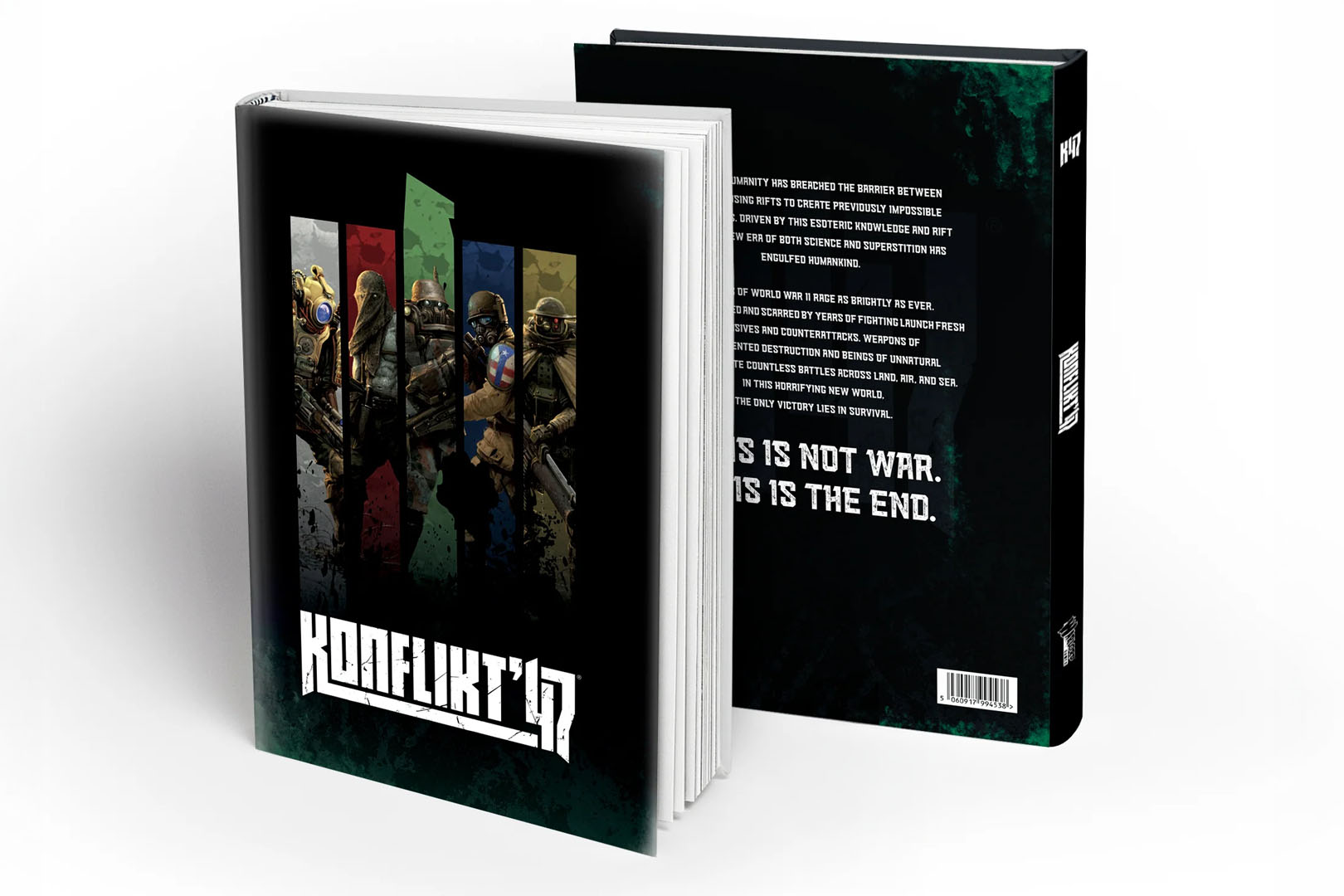
Konflikt '47 is not the first game to go down that road. AE-WWII by Darkson Designs was around as early as 2006, and Paolo Parente's Dust universe made it big with Dust Tactics and Dust Warfare at Fantasy Flight Games, followed by Dust 1947 under his own studio. Konflikt '47 started out as an independent product by Clockwork Goblin, was taken into a distribution partnership by Warlord Games around 2014, saw its first edition rulebook published by Osprey in the summer of 2016, just a few months before Bolt Action second edition. Rules-wise, it sat somewhere in the middle between the first and second edition of Bolt Action. In 2022 Warlord Games bought the game, the range and the rights. In September 2025 the new edition was released, now based on Bolt Action third edition, and after reviewing the Bolt Action core rules it is the logical next step in our series.
The original game was created by Chris Hale, Ben Moorhouse, Aitch Parker and Stu Williams of Clockwork Goblin. The new edition was written by Andy Chambers, Roger Gerrish, Dan Hewitson, Bill King, Cam Rogers, Gav Thorpe, Marcus Vine and Ady Wood, on the foundation of Bolt Action by Alessio Cavatore and Rick Priestley. Some of these names will sound very familiar to anyone who grew up with Games Workshop in the nineties. Osprey is no longer involved in this edition, Warlord Games publishes it on its own. The rulebook comes as a 202 page hardback for 48 EUR and is only available in English, either in print or as a digital PDF. This review is based on the PDF, provided as a review sample.
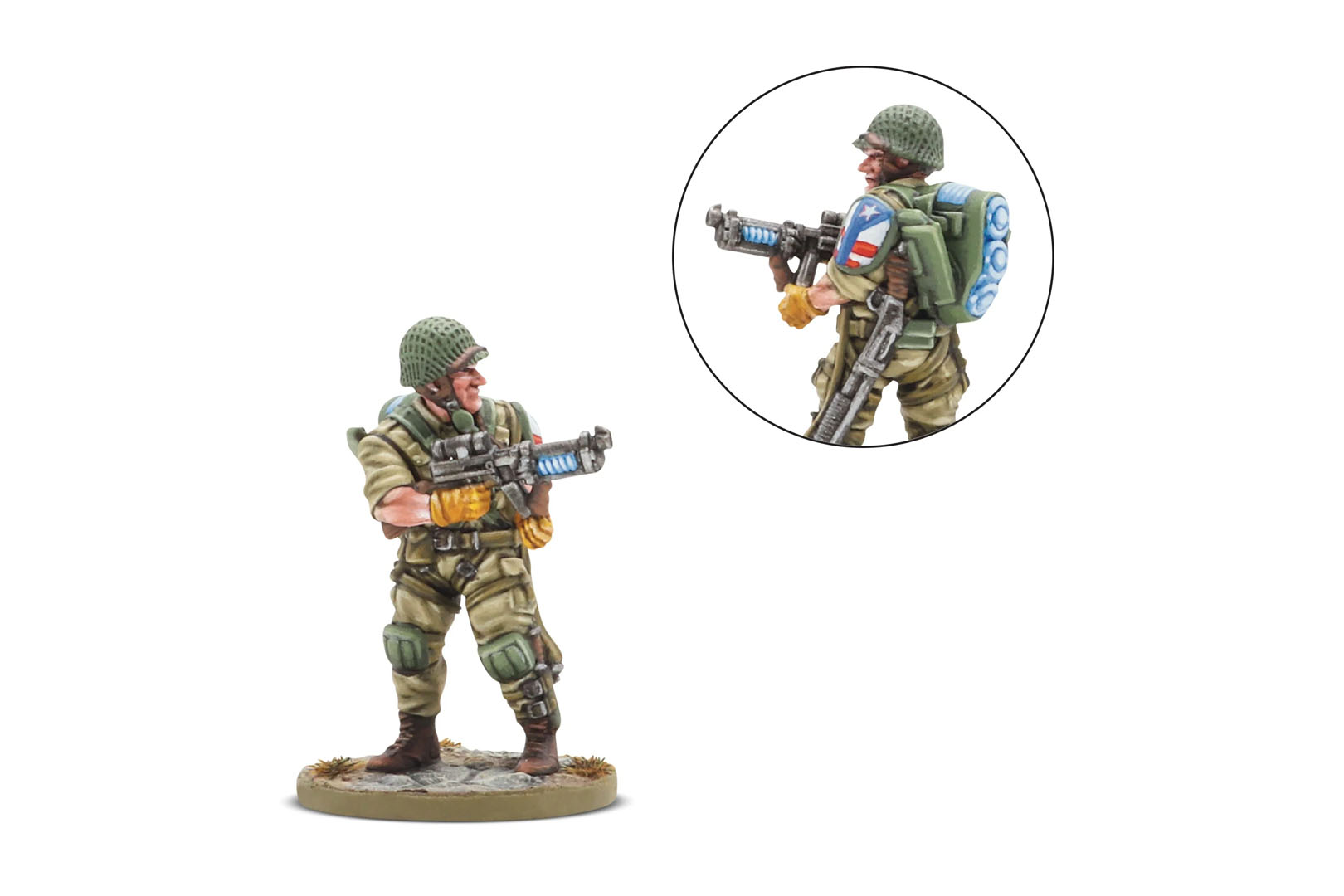
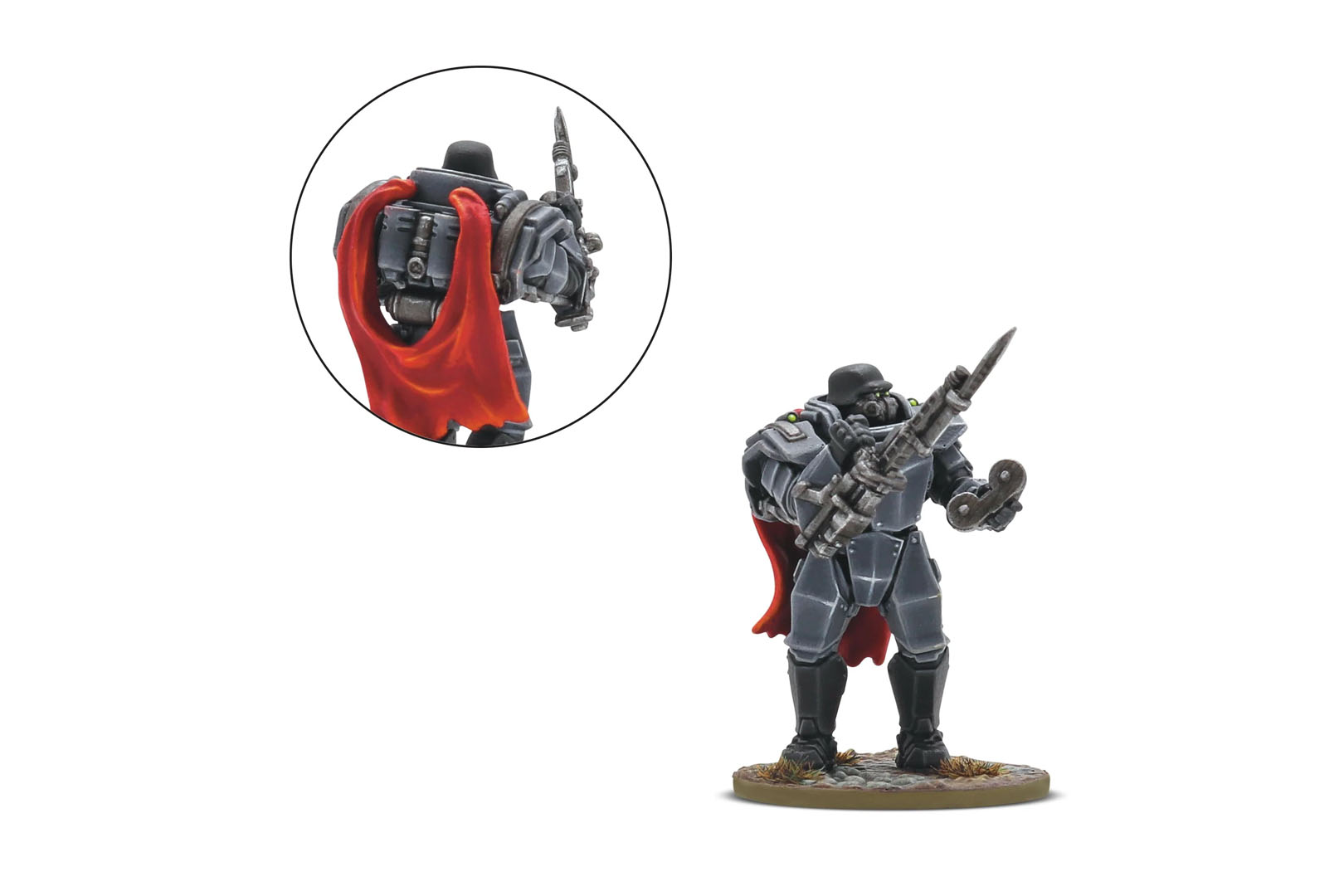
As with the Bolt Action rulebook, ordering directly from Warlord Games or selected retailers gets you a free special miniature, and this time you get to choose between two. Both are called "Reload!" and show a soldier mid-reload: one is a US Firefly jump trooper, the other an Axis Stahltruppen heavy infantryman in powered armour. They were sculpted by Marco Sano and painted by Kirsten Williams for the official photos, and they represent the two factions of the current starter set.
What is it about?
Konflikt '47 is a Weird War wargame in 28mm, played at platoon level just like Bolt Action. A standard game is played at 1,500 Requisition Points on a 6' by 4' table. The forces are a mix of conventional infantry, powered armour, walkers, tanks and units that have been changed by an energy that should never have reached our world.
That energy comes from the Rift. In the world of Konflikt '47, scientists of the Manhattan Project accidentally tear open a gap into another reality while working on the atomic bomb at Los Alamos. The bomb is built anyway, but it is not dropped on Japan. It falls on Dresden, and with it a second Rift opens in the heart of Germany. What pours out of these Rifts is energy and knowledge alike, and both sides start using it for weapons that were unthinkable only months before.
In Germany, a secret society called the Green Vault, which has been pulling strings since the days of Augustus the Strong, uses the chaos to seize power. The politicians of the Third Reich are discarded, and with them their symbols, so the Axis is now led by the "Neu Republik". In the United States, President Roosevelt visits the Los Alamos Rift and is cured of his illness. The 22nd of April 1944 is declared "Miracle Day", and America sets out on a religiously charged crusade against Nazism, Japan and Communism alike. On the 1st of May 1944, Stalin breaks the alliance with the West. Three years later, in 1947, the war is still raging.
I welcome that Konflikt '47 manages without the swastika. It is not a new trick either, Dust did something similar years ago and wrote a change of leadership into its background, which at least shifts the symbolism. For a game about Weird War this is the more elegant way, and it fits Warlord's generally careful handling of the period.
The Factions
The Axis under the Green Vault stands for the occult side of the Rift. The undead legions of the Totenkorps march ahead of Stahltruppen heavy infantry in powered armour, supported by Schwarzlicht weapons, gravity projectors and walkers like the spider-legged Vogelspinne. Officially, all of this is the result of scientific progress. Unofficially, the rumours about what happens in the laboratories of Dresden are a lot darker.
The United States fight with the zeal of crusaders and the industrial might of a nation that has found its own miracle. Their soldiers carry Tesla weapons, Firefly jump troops fly into battle with rocket packs, and walkers like the M2A5 Linebacker leap across the battlefield.
Great Britain and the Commonwealth rely on the minds of Bletchley Park. Their greatest achievement are the Automated Infantry, mechanical soldiers controlled by thinking machines, alongside Galahad heavy infantry in powered armour and some very British understatement.
The Soviet Union got its hands on Rift technology mostly through espionage and makes up for the rest with brute force and genetic experiments. The Ursus infantry are soldiers merged with bears, the Moroz Gul are Siberian terror troops that do not seem to feel the cold at all, and sonic weapons tear apart whatever the Kazak walkers leave standing.
The Empire of Japan built its Rift technology on Axis knowledge, and its own developments are no less unsettling. "Phasing" lets troops shift out of reality for a moment, Shiboru weapons crush their targets, and walkers like the Batta add mobility. And there are the Three Sacred Treasures, which all reacted in some way on the day the bomb fell on Dresden.

First Impression
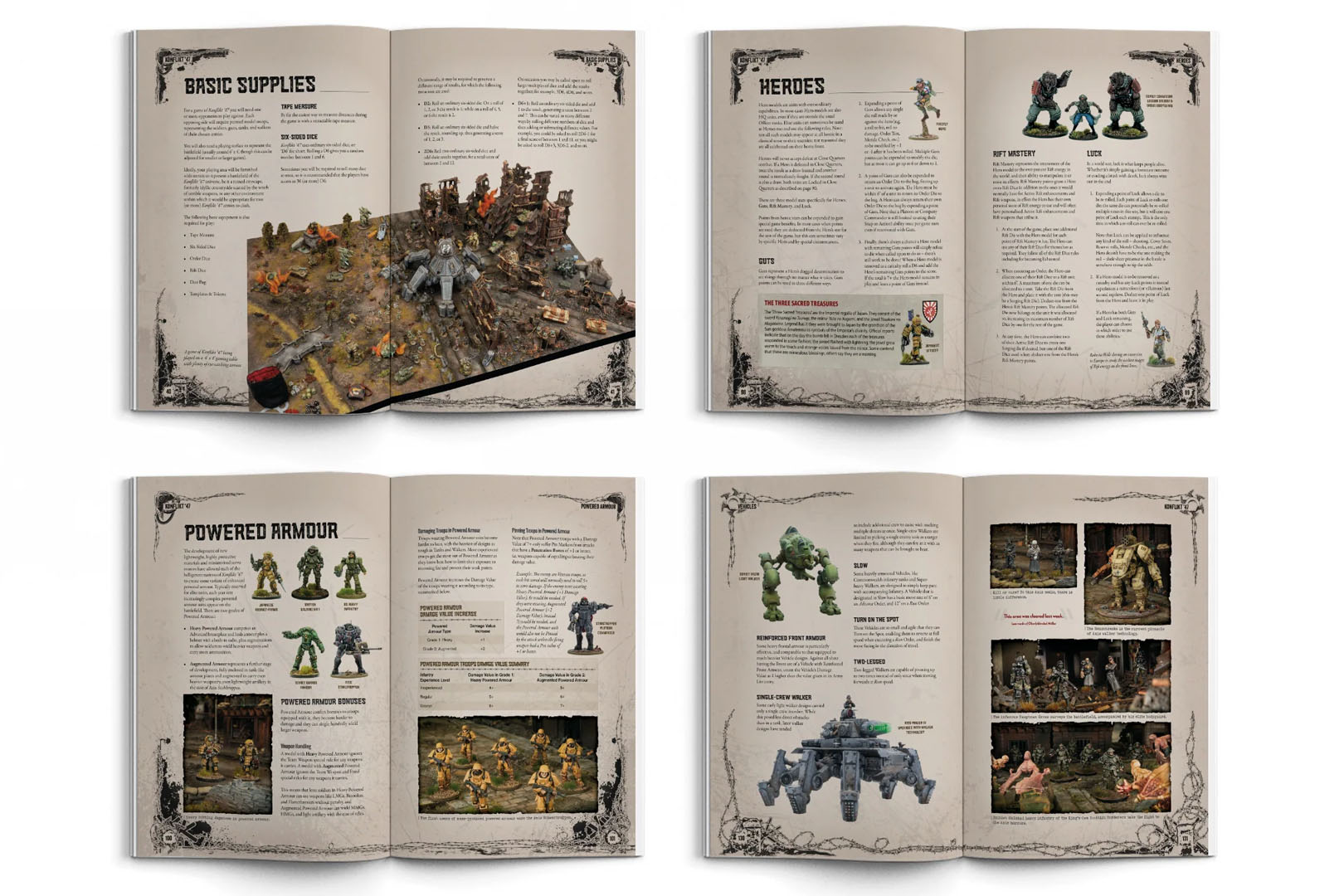
The design differs significantly, not only from the Bolt Action rulebook but also from the first edition of Konflikt '47. It has become a lot darker and carries the whole Götterdämmerung theme very strongly, which really shows in the layout. The overall tone is occult rather than horror, and the artwork by Stefan Kopinski together with the photos of the miniatures supports this well.
The book is structured much like the Bolt Action rulebook:
- Introduction and the World of Konflikt '47
- The Turn, Orders, Movement and Shooting
- Weapons, including Advanced Small Arms and Rift Weapons
- Close Quarters, Headquarters, Heroes and Powered Armour
- Unit Special Rules, Artillery, Vehicles, Walkers and Buildings
- Arranging a Game and the Scenario system
- Force Selection with the Core Platoon Selectors
- Rules Summary and Index
What you will not find in the book are army lists. They are available as free downloads on konflikt47.com and are updated as new units, upgrades and heroes are released. That is a somewhat odd decision, as it feels like the lists were not finished in time for print. I would have expected a rudimentary list in the book, to be expanded later on in campaign books. And the PDF lists are by no means thin, depending on the faction we are talking about 35 to 50 pages each.
On the other hand, Weird War is still a niche, so I would not expect Armies of... books like for Bolt Action. Printing costs for a core rulebook of 300 pages or more were probably too high, and you cannot cut the army lists down without losing too much of the paranormal flair, given all the new technologies. So it is a compromise, an understandable one, and thanks to the free and constantly updated lists an acceptable one for the customer as well. Some systems go that way entirely, with free core rules and monetisation through miniatures or campaigns.
How does it play?
At its core, Konflikt '47 is Bolt Action third edition. Order dice are drawn blindly from a bag, units receive one of the same six orders, and pin markers wear down morale. You hit on 4+ with the same four modifiers, cover is resolved with cover saves after rolling to damage, and the damage values, the building rules and the scenario generator are all identical. If you know Bolt Action, you can start playing right away, and I will not repeat the basics here. Have a look at our Bolt Action review for a detailed walkthrough.
But Konflikt '47 needs to set itself apart, and the rulebook is flexible enough to need an additional layer. Otherwise, many weapon systems or units would boil down to "ah, okay, that plays like an anti tank gun" or "those are basically Veterans" with different models.
Rift Dice
The most important addition is the Rift Dice. Every Rift unit, and every conventional unit upgraded with a Rift weapon, brings its own Rift Die into play. Each die has one Surging face, two Active faces and three Exhausted faces. Rift units start the game with an Active die, which powers special abilities or Rift weapons. Using it exhausts the die, while a Surging die drops back to Active, unless it is used to overload a weapon, which often comes with nasty side effects for the user.
At the end of the turn, all Exhausted Rift Dice are rolled again. Dice showing Active or Surging go straight back to a Rift unit, everything else ends up in the dice bag along with the order dice. If a Rift Die is drawn, the owning player rolls it and assigns it to one of their Rift units. This adds a resource layer to the blind draw, which is a concept we have already seen with special dice in several of Joseph A. McCullough's games, and Mortal Gods does something similar with its Omens. It can work, depending on the size of the game and the total number of dice involved.
Heroes
Heroes are upgraded considerably compared to Bolt Action. They come with three special stats. Guts allows you to modify any die roll by or against the hero by +1 or -1, to return an order die to the bag so a nearby unit can activate again, or to simply refuse to die. Luck re-rolls any die, even the opponent's cover saves, and offers a last second reprieve when the hero should be removed as a casualty. And Rift Mastery grants additional Rift Dice for the hero's personal abilities. On top of that, heroes never accept defeat in close quarters.
This takes the game another step towards the cinematic, towards pulp superheroes. In the context of Konflikt '47 this is legitimate, and it sets the game apart from Bolt Action once more. Bolt Action takes its cues from the British war comics, and Konflikt '47 takes this idea a bit further by bringing (super)heroes into play. Not as shiny and radiant as Captain America, though, but suitably dark. And it holds back. Konflikt '47 does not become a "Herohammer" version of Bolt Action, the heroes only set accents within the framework of the existing rules.
Powered Armour and Special Rules
Powered armour increases the damage value of infantry by +1 for heavy armour and +2 for augmented armour, so a Veteran in augmented armour needs to be damaged on a 7+. Units with a damage value of 7 or more can only be pinned by weapons with a Pen value of +1 or higher, and a single trooper in powered armour can wield an LMG or bazooka, in augmented armour even an HMG or light artillery, without needing a team. To keep this in check, in close quarters a 6 followed by another 6 always causes damage, no matter how tough the target is.
Many more unit special rules were added. Flight allows infantry to move up to 12" with an Advance and 18" with a Run order while ignoring terrain, and walkers with the Jump rule leap over obstacles in a similar way. Both can even drop directly onto the table from reserve, with nearby enemies allowed to react with fire. Hard to Kill grants +2 to cover saves or a 5+ save in the open, Horror forces enemies to pass a morale check before they can react to an assault, and Deadly lets a model roll several dice in close quarters. At the other end of the spectrum, Green troops might run at the first casualty or turn into Regulars, and Shirkers count every pin marker double.
Close Quarters
This is where Konflikt '47 deliberately departs from Bolt Action. In Bolt Action an assault is decisive, and the loser is wiped out. In Konflikt '47, a drawn combat is followed by a second round, and if that ends in a draw as well, both units are Locked in Close Quarters. The game continues, and after each order die that is drawn and resolved, the locked units fight up to two more rounds, until one side emerges victorious. Fearless units and heroes even turn a defeat into a draw, so they never give up as long as there is a model left.
This takes some pace out of the game, but it is necessary. Konflikt '47 has a lot more units with a strong close combat focus than Bolt Action, where they do not exist or only in a very limited form. If close quarters were just as quick and brutal here, there would be no point in fielding these units.
Walkers and Weapons
Walkers are treated as vehicles with damage values from light to super-heavy, just like tanks. Multi-legged walkers can reverse at full speed, two-legged walkers can pivot twice when running, and some early light walkers only carry a single crew member, so they can only engage one target at a time. Some conventional tanks have even been upgraded with walker technology, like the Axis Panzer IV.
The weapons chapter adds advanced small arms with different firing modes, like the Thompson M1X with its E-Slug or the Soviet Poykbi weapons, as well as a separate chart for Rift weapons. Tesla rifles and cannons, gravity projectors, sonic weapons, the Japanese Shiboru weapons, a railgun with a range of 96" and a meteor launcher all come with their own Rift effects that can be triggered or overloaded with Rift Dice.
Force Selection
The standard game size was raised from 1,000 to 1,500 points. We are in late war territory here, and units are on average more expensive than in Bolt Action, so the larger framework is necessary. Units are divided into Basic, Advanced and Specialist. Basic units would fit into any army of the early to mid forties, Advanced units carry Rift-influenced equipment, and Specialists are exceptional troops with direct Rift-powered abilities. The Assault Platoon takes the place of the Rifle Platoon, joined by Heavy Weapons, Engineer, Artillery, Armoured, Armoured Walker and Recce Infantry platoons.
And here lies one of the strengths of the system. If both players agree, units from the Bolt Action Armies of... books and army lists can be used in Konflikt '47. Where both games share a rule, the Konflikt '47 version applies. This hybrid approach lets you choose how full on horror or sci-fi you want to go. Personally, I prefer a more "believable" Weird War that stands out through the paranormal and the occult, combined with the Panzer '46 and '47 aesthetic, rather than weapon systems that would still be considered science fiction fifty years later. A Silver Bayonet for World War 2, so to speak, would be my ideal scenario, and with this rule set you can get pretty close to it.


What's next?
As mentioned above, the army lists for all five factions are available as free downloads and are regularly updated with new platoons and units. Instead of army books, Warlord Games supports Konflikt '47 with a series of campaign books called The Rift War:
- The Rift War Volume One: Festung Europa (March 2026)
- The Rift War Volume Two: Invasion Amerika (August 2026)
- The Rift War Volume Three (pre-order announced for November 2026)
Festung Europa covers Western Europe from 1944 to 1947 with three campaigns, Operation Valentine, Operation Pluto and Operation Touchdown, each with a timeline, a hero and a large concluding scenario, plus short stories. Invasion Amerika follows Japan's attack on the American heartland. Both books come with their own special miniature and cost 36 EUR each, or 24 EUR as PDF. Should these books find their way to us, we will of course cover them in this series as well.
Conclusion
As far as the rules are concerned, Konflikt '47 does a lot right. It builds on a solid foundation in Bolt Action third edition and adds exactly the layers it needs to stand on its own. Rift Dice, heroes and powered armour give the units their own identity, without turning the game into something completely different. Anyone coming from Bolt Action will feel at home after a few turns.
As I am a very visual person, my criticism of Konflikt '47 concerns the range rather than the rules. As the game started out as an independent external product, a lot still needs to be consolidated design-wise, and that takes time and costs money. For many models I am missing a common thread within the range. Partly it is the differing scales and proportions, especially when you mix with Bolt Action, and the level of detail also varies a lot across the different production periods. The latest releases are clearly better, but Paolo Parente set the bar for a "believable" and coherent design so high with Dust some 10 to 15 years ago that you have to stretch quite a bit to keep up.
The missing translations are certainly a point worth mentioning, but given that this is an even narrower niche than Bolt Action, it is understandable that there are none (yet?).
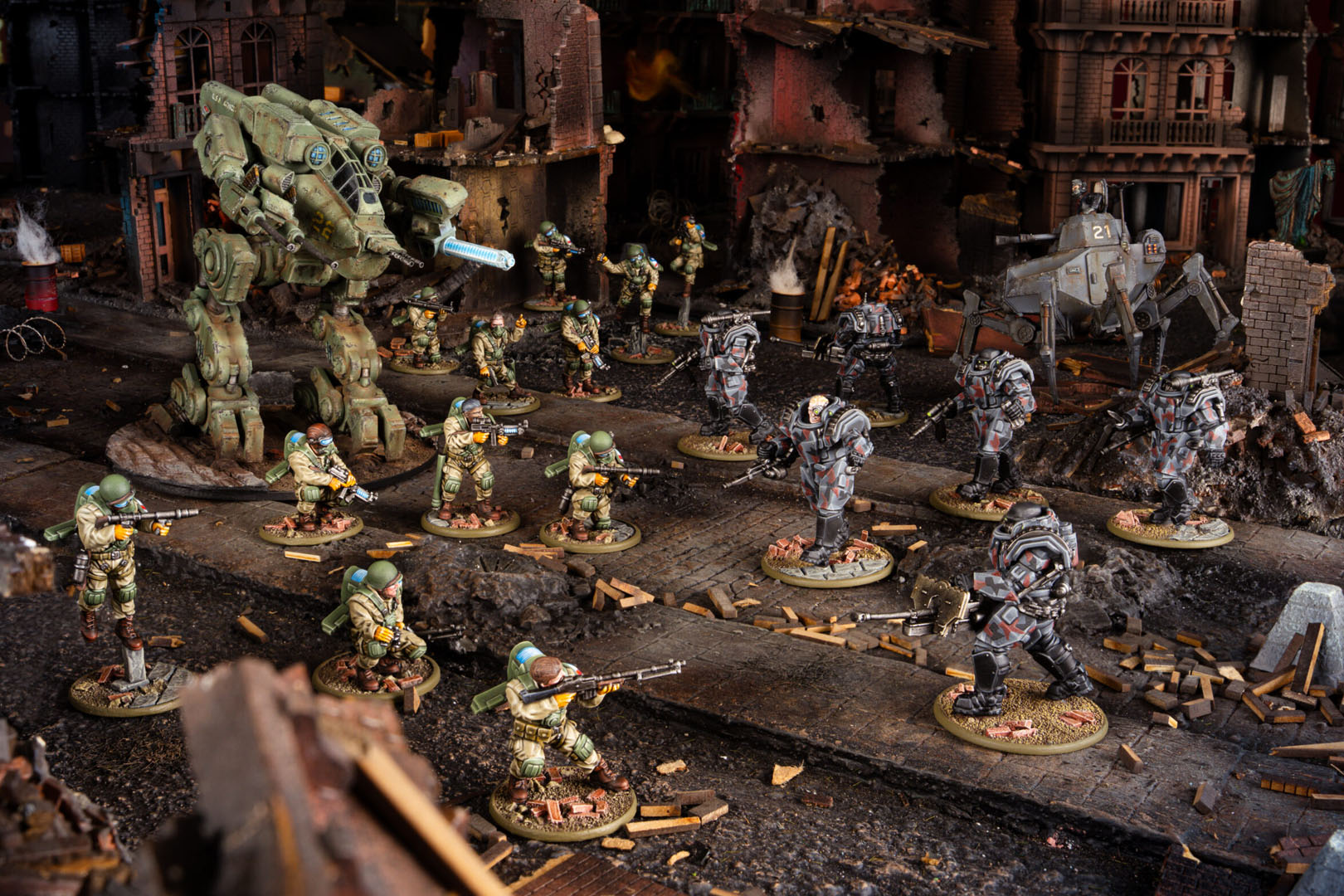
There are several options to get into Konflikt '47. The cheapest is the digital rulebook as a PDF at 24 EUR, followed by the mini rulebook at 26.50 EUR and the hardback with special miniature at 48 EUR. If you want to dive right in, there is the Introductory Set at 51 EUR with twelve Fireflies, six Stahltruppen, a ruined building and a 68 page field manual for your first games, and the large Starter Set at 114 EUR. The latter pits the Axis with a platoon commander, six Stahltruppen and a Vogelspinne light walker against a US platoon commander, twelve Firefly airborne infantry and an M2A5 Linebacker jump walker.
So who is it for? Thanks to the free army lists, Bolt Action players can find a soft way in and add one or two units to their games, in agreement with their opponent. That would be the low horror approach. For Weird War fans, Konflikt '47 is a valid option that is a lot easier to get hold of through Warlord Games' large distribution network. And should the aesthetic stand in your way, take the rules and convert your own models, there are plenty of possibilities. Personally, I would have liked the two ranges to be closer to each other, but let's see what the next waves bring for the system.
Konflikt '47 is a brand of Warlord Games.
The reviewed product was provided by the manufacturer.
Enjoy this article?
Like us on Facebook
Follow me on Instagram
Categories
- battle report (5)
- events (217)
- fantasy (620)
- General (162)
- historical (657)
- Little Big Adventures (4)
- offtopic (5)
- reviews (561)
- science fiction (722)
- showroom (108)
- terrain (120)
- work-in-progress (426)








Leave a comment