Stargrave – Quarantine 37
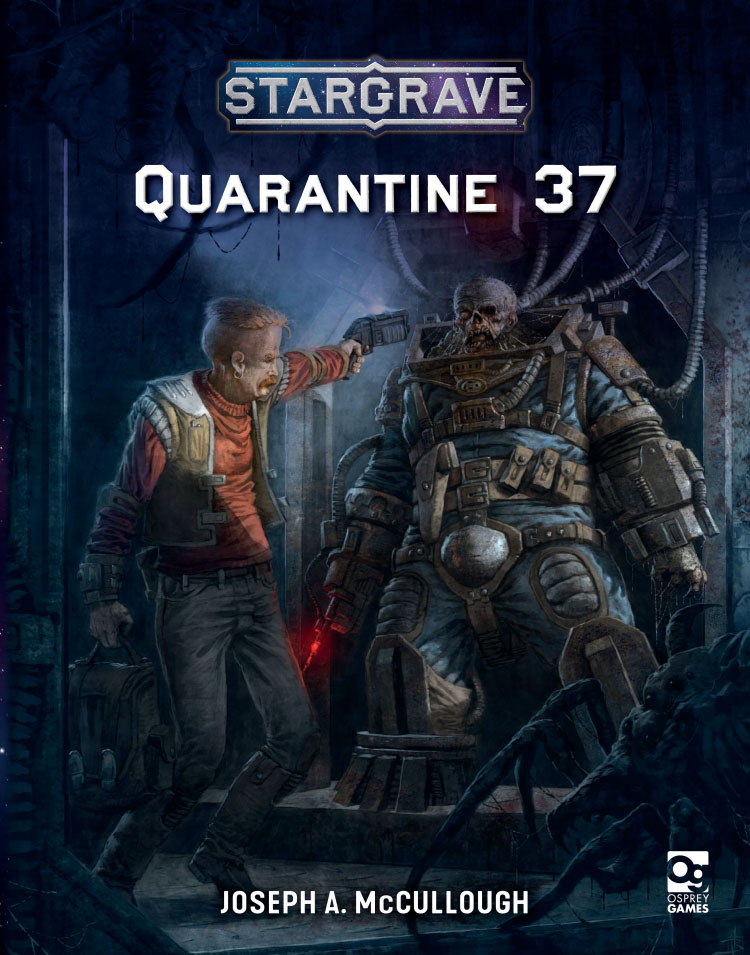
We covered Stargrave extensively over the years on this blog, starting with the core rulebook and the several plastic kits for Crew, Troopers, Mercenaries, Scavengers and Automatons. The last supplement we took a look at was Dead or Alive, the solo supplement that started as a free PDF and received a major overhaul in 2024. Now it is time to work through the remaining supplements – and that means going back to where it all started: Quarantine 37, the first full supplement for Stargrave, released back in 2021.
What is it about?
Imperial Research Station 37 once housed nearly ten thousand scientists working on biological and chemical research. Six months before the Last War, it went dark – no distress signals, no escape pods, just a single repeating broadcast: This station is under quarantine. Do not approach. Now, with the war over and independent crews picking through the ruins of the galaxy, the station has been rediscovered. Whatever happened there, the technology inside is worth a fortune.
That is the setup for Quarantine 37, and it is a good one. Joseph A. McCullough freely admits in the introduction that he could not decide between two classic sci-fi horror archetypes for this supplement, zombies or alien bugs, and in the end simply chose both. The station is big enough for both threats, depending on which airlock you enter through.
The result is two separate mini-campaigns of four scenarios each. The first, The Shuffling Dead, sends the crews deep into the zombie-infested sections of the station before they are surrounded and have to fight their way back to the ship. The second, Strike from the Shadows, pits the crews against a swarm of alien bugs that herd them steadily deeper into the hive, culminating in a face-to-face encounter with the alien queen. Beyond the scenarios, the book adds two new captain backgrounds (Aristocrat and Hunter), eight new powers, six new soldier types, a table of advanced technology to loot from the station, and a bestiary covering zombies, bugs, and everything in between.
First Impression
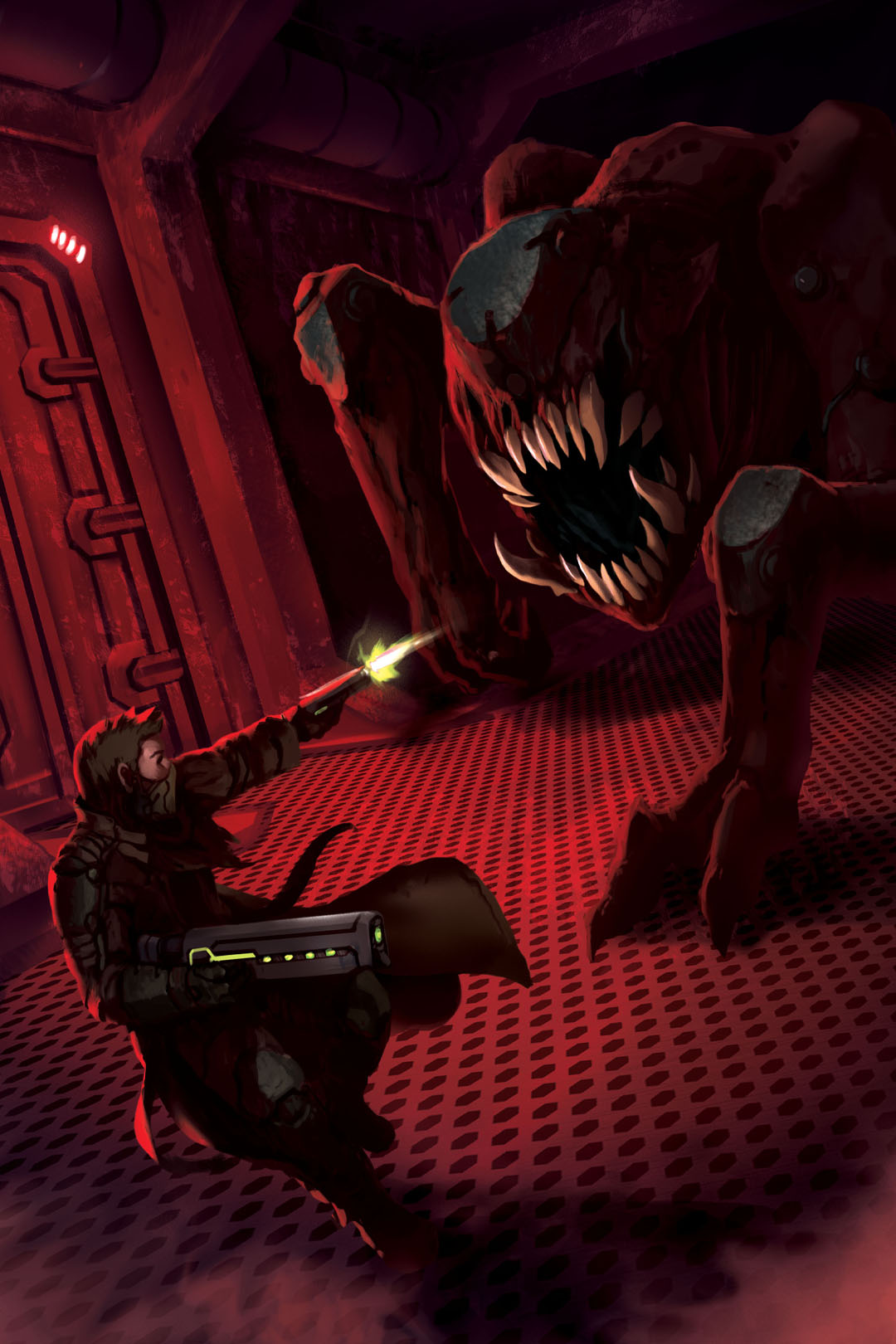
Quarantine 37 is a 96-page softcover, matching the production quality of the core rulebook. The layout is clean and consistent, the illustrations by Biago D'Alessandro are vivid and atmospheric, and the scenario photography shows tables that are properly built for the science fiction horror setting.
- Chapter One: New Backgrounds and Powers
- Chapter Two: New Soldiers and Rules
- Chapter Three: The Shuffling Dead (4 Scenarios - Zombie Campaign)
- Chapter Four: Strike from the Shadows (4 Scenarios - Alien Campaign)
- Chapter Five: Going Solo (Solo Rules, adapted from Dead or Alive)
- Chapter Six: Back to the Ship! (4 Scenarios - Solo Campaign)
- Chapter Seven: Advanced Technology
What stands out immediately is how purposefully the two campaigns are designed around their respective threats. The zombie campaign draws a clear line back to classic siege horror, the slow advance, the limitless numbers, the creeping inevitability of it all. If you ever played Doom and wondered what that would look like on a tabletop, the Shuffling Dead campaign is a reasonable answer. The bug campaign, on the other hand, is unambiguously Alien. The creatures stalk from the shadows, the tension builds through a ping system that keeps players guessing what is closing in on them, and it all escalates toward a queen encounter. These are not subtle references and that is entirely the point. McCullough leans into both tropes with full commitment, and the scenarios are built to deliver exactly those experiences.
The new soldier types, particularly the Ravaged (infected survivors stumbling between zombie and living status) and the Trophy-taker (a barely disguised Predator) – are good additions that fit the setting tightly rather than feeling like padding.
How does Quarantine 37 play?
Both campaigns use the competitive format from the core rulebook: two crews racing for loot while the environmental threats do their best to ruin everyone's day. The zombie campaign introduces Hastian's Plague and reanimation rules. Soldiers killed by zombies can rise again, which adds a layer of dread to every close-combat result. The alien bug campaign uses the ping system, where unmarked counters move across the table and are only revealed when they come into line of sight of a crewmember. Sometimes it is nothing. Sometimes it is three Warrior Bugs. The uncertainty is the point.
The scenarios themselves are well-constructed and escalate naturally within each campaign. The first scenario of The Shuffling Dead starts controlled – a medical lab where plague zombies can emerge from pods at the end of each turn – and by the fourth, the crews are fighting through a horde just to reach the exits. The bug campaign follows the same logic in reverse, starting tense and ending in a throne room with the queen.
Chapter Five adds a four-scenario solo campaign built from adapted scenarios from both campaigns. The solo rules modify the turn sequence to make creatures more threatening, for example the Creature Phase is inserted immediately after the Captain Phase. It is rudimentary by design, as McCullough acknowledges, and those who have since read Dead or Alive will recognise this as the seed of what that supplement expanded so significantly in its 2024 overhaul.
What's next?
Quarantine 37 was the first of six supplements for Stargrave. The others are:
- Dead or Alive – Solo Play rules for Stargrave
- The Last Prospector – asteroid-to-asteroid manhunt with zero gravity and jungle environments
- Hope Eternal – a dedicated solo and cooperative campaign
- Side Hustle – a card deck with 40 side hustle missions and tasks
- Bold Endeavour – rules for the crews' ships as strategic bases and story tools
- Death Vector – adding Terminator and Cyberpunk to the game.
- Accetable Losses – the next supplement coming in November 2026
We will work through the remaining supplements in the coming months.
Conclusion
Quarantine 37 does exactly what a good first supplement should: it takes the open framework of the core game and fills it with content that feels thematically coherent rather than arbitrarily added. Two campaigns, two classic sci-fi horror archetypes, both handled with commitment and without apology. The zombie campaign channels Doom, the bug campaign channels Alien, and both deliver the kind of tense, narrative skirmish gaming that Stargrave does well.
The new backgrounds, soldiers, and powers integrate cleanly with the existing rules rather than complicating them. The solo campaign is a stepping stone rather than a destination, but it earns its place in context of where the game's solo content eventually ended up.
If you own the Stargrave core rules and want to know whether this is worth adding: yes, it is. It is available as a paperback for 20 GBP or as a digital edition for 16 GBP from Osprey, and represents solid value for the content provided.
Stargrave is a brand of Osprey Games and North Star Miniatures.
The reviewed product item was provided by the manufacturer.
Enjoy this article?
Like us on Facebook

Follow me on Instagram

Categories
- events (210)
- fantasy (604)
- General (161)
- historical (644)
- Little Big Adventures (4)
- offtopic (5)
- reviews (552)
- science fiction (710)
- showroom (107)
- terrain (119)
- Uncategorized (1)
- work-in-progress (422)










Leave a Reply